

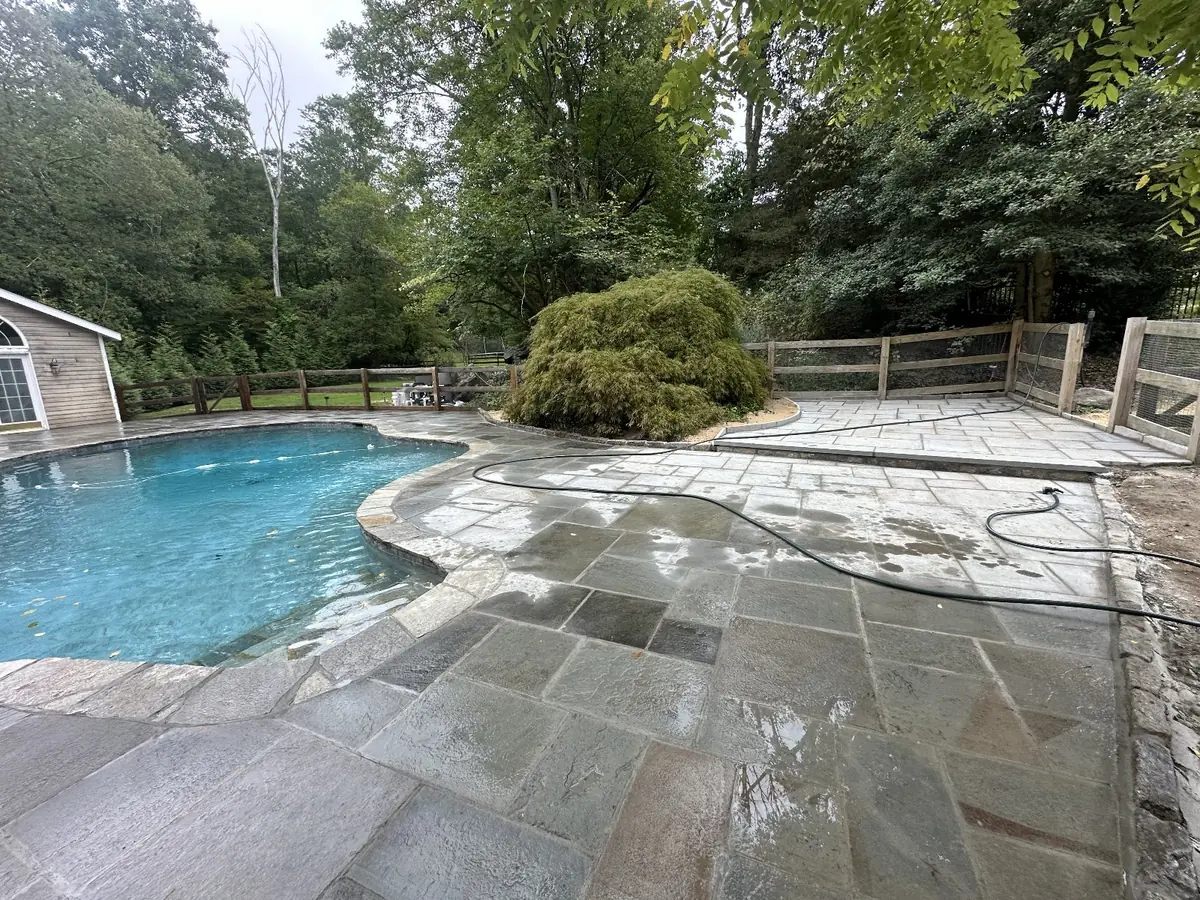
Stone walls, patios and walkways that still sit right years from now
Retaining walls, stone walls, bluestone patios, steps, walkways and stone veneer, built by our own crew across Westchester County and Greenwich. Nelson walks the property, writes the price, and is on site while the work goes in.
Key findings
- About 69 freeze-thaw days a winter. Westchester County Airport averaged 68.9 days per winter season with a high above 32F and a low below 32F (NOAA GHCN-Daily station USW00094745, July 2015 to June 2025, 10 seasons; range 55 to 81).
- 1 of 105 reviews talks about durability. Of 105 public Google reviews of five other Westchester landscaping companies, one described how hardscape held up over time (our review study, read September 2026).
- Rock and water sit close to the surface. 42.4% of rated soil acres in Westchester have bedrock within 40 inches and 21.3% have a seasonal water table within 18 inches (USDA NRCS SSURGO, survey NY119).
Will it still look right in five years?
This is the question the public record rarely answers. In September 2026 we read 105 public Google reviews (full review study) of five other Westchester landscaping companies. One of the 105 described how a wall or walkway held up over time, and two mentioned drainage results. Crew courtesy came up in 63 of them. People talk about the day the crew was there, not the winters after.
So here is what decides the five year answer, and what you will see first if it is going wrong.
Why the base matters so much here
Freeze-thaw is the test every patio and wall takes, and this county gives it often. At Westchester County Airport, the number of days that crossed the freezing line (high above 32F, low below 32F) in each winter season:
| Winter season | Freeze-thaw days |
|---|---|
| 2015-2016 | 65 |
| 2016-2017 | 60 |
| 2017-2018 | 81 |
| 2018-2019 | 80 |
| 2019-2020 | 69 |
| 2020-2021 | 74 |
| 2021-2022 | 71 |
| 2022-2023 | 71 |
| 2023-2024 | 63 |
| 2024-2025 | 55 |
| Mean | 68.9 |
Source: NOAA GHCN-Daily, station USW00094745, July 2015 to June 2025, our analysis. The same record shows a mean of 10 days per season with an inch of rain or more.
Every one of those days is a chance for water trapped in a base or behind a wall to freeze and push. Roughly 69 of them a winter is why base depth, drainage behind walls and a true double wall for dry-laid retaining work are not optional here.
The ground adds its own variables. In the USDA NRCS soil survey for Westchester (SSURGO, NY119), 42.4% of rated soil acres have bedrock within 40 inches, 21.3% have a seasonal water table within 18 inches, and 46.6% fall in hydrologic group C or D (including dual groups that act like D when the water table is high), meaning water soaks in slowly. The most common map units are Charlton-Chatfield "very rocky" complexes. That is why two jobs of the same size can need very different excavation: one yard digs easily, the next hits ledge or standing water.
Water under a patio or behind a wall freezes, expands and lifts what sits on top of it (one of our published jobs below shows exactly this). That is why day one on a masonry job is usually excavation and base work: we dig past topsoil to ground that will not compress, then build back up with crushed stone compacted in lifts. Anything rigid gets a footing below frost depth, and your local building department sets that depth: ask them for your address. Drainage is part of the masonry scope, not a separate trade afterward.
What shows up first when a job was built wrong:
- Patio or walk: one corner or one edge drops while the rest stays flat. That is a base problem in one place, not a joint problem.
- Mortared steps or wall: a crack that runs through the mortar joints in a stair-step line, or a tread that rocks.
- Retaining wall: a belly in the face, a top that leans out past the bottom, or wet soil at the base after rain. Our guide to reading a retaining wall that is moving walks through each sign.
Three jobs from our published work
The Problem, What was done and Result lines come from the project write-ups on our work page, in the words published there. The "Why it matters here" notes are our commentary, tying each job to the roughly 69 freeze-thaw days a winter measured above.
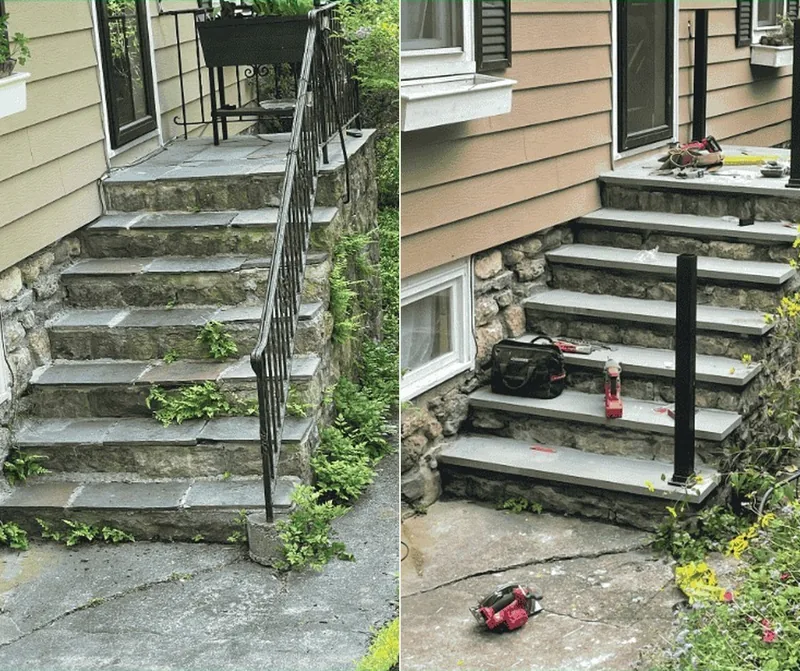
Stairs and retaining wall rebuilt as one structure, Westchester County, NY
Problem: A failing set of outdoor stairs and the retaining wall beside them, moving apart from each other after years of water getting behind both.
What was done: Took both down and rebuilt them together: excavation behind the wall line, a compacted stone base, drainage behind the new wall, and treads reset course by course as the wall came up. Natural stone treads and wall stone on a compacted crushed-stone base.
Why it matters here: The result was one structure instead of two leaning on each other, with the water that caused the failure now routed out instead of trapped behind it. Trapped water is what each freeze-thaw day acts on, so the drainage was the repair, not an extra.
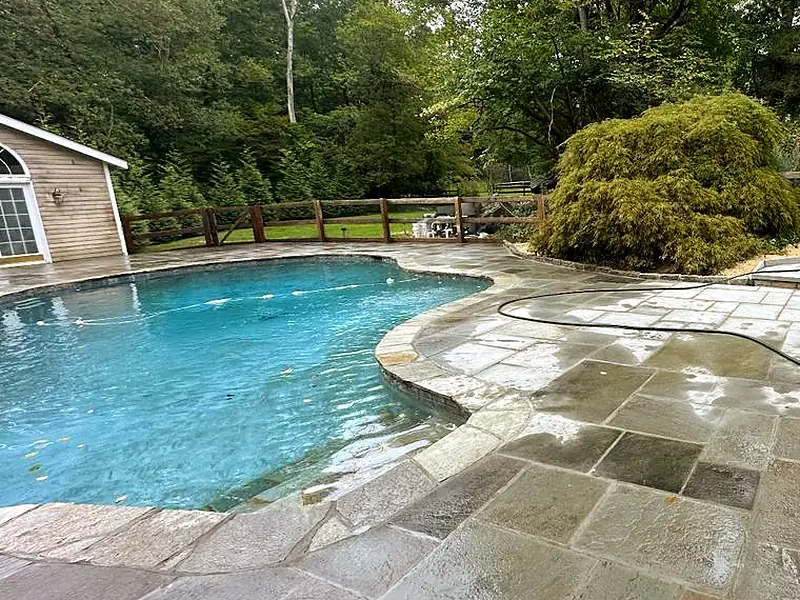
An overgrown pool patio brought back, Westchester County, NY
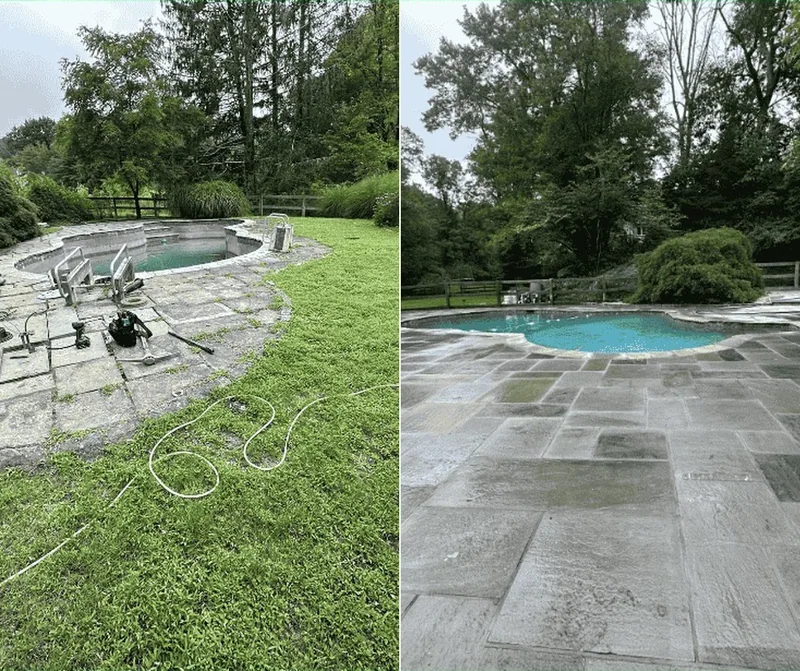
Problem: A bluestone pool patio that grass had overrun, with joints lost to turf and stones settling out of level around the pool.
What was done: Lifted the field, corrected the base underneath, re-set the same stone, and cleaned the surround back to a working patio. The original bluestone, re-set rather than replaced.
Why it matters here: Settling stones point to the base, so the base was corrected, not just the joints. The result: the patio the owners already paid for once, back in service without buying new stone.
Bluestone pool surround, Mount Kisco, NY
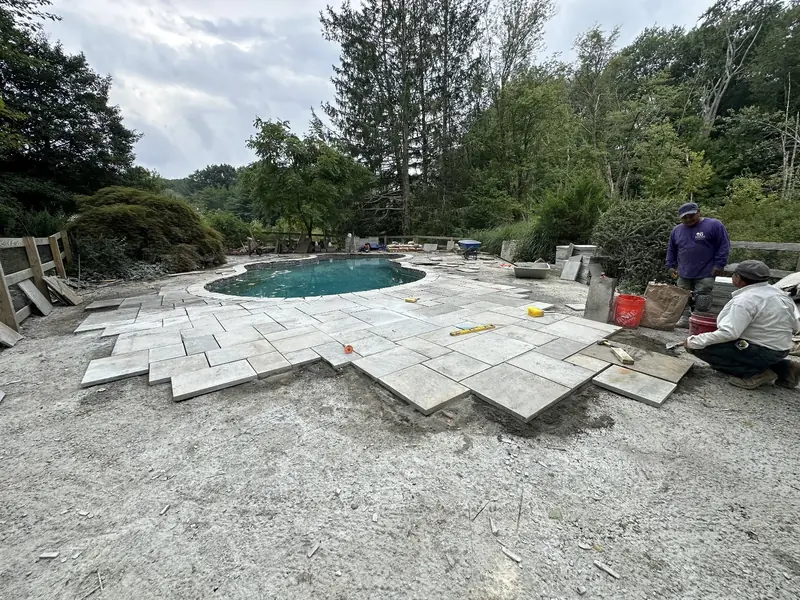
Problem: Pool deck needed a finished stone surround that would drain through freeze-thaw cycles.
What was done: Irregular bluestone set around the pool with pitch away from the coping. Bluestone, compacted base, drainage behind the stone.
Why it matters here: Finished surround pitched so meltwater does not sit against the stone. Meltwater that sits is water that refreezes on the next freeze-thaw day.
Every job here starts the same way: a twenty-minute walkthrough and a written price.
Dry-laid or mortared: which fits your situation
Both last when built for the job they are doing. The mistake is using one where the other belongs.
Dry-laid fieldstone is best for a boundary or garden wall on open ground, because it can shift slightly with freeze-thaw and settle back without cracking, and a stone that moves can be reset without chipping out mortar. It also matches the old walls that run through most yards north of White Plains.
A dry-laid wall that holds back soil should be a double wall, because that is the type built to retain. The Stone Trust, a nonprofit that trains and certifies dry stone wallers, describes the double wall (two faces with small stone packed between them, tied by through stones) as "the correct building type for retaining walls," and says single stack walls "are not suitable for retaining walls" (thestonetrust.org, Common Walling Types, read September 2026).
A dry fieldstone retaining wall should lean back into the hill, because it holds soil by its own weight. Landscape architects writing for the American Society of Landscape Architects give a typical batter of 2 to 3 inches per vertical foot on fieldstone walls, and 1 to 2 inches on more structured walls (ASLA, "Dry Stacked Stone Walls," 2015). A wall whose face is plumb or tipping forward has lost that lean.
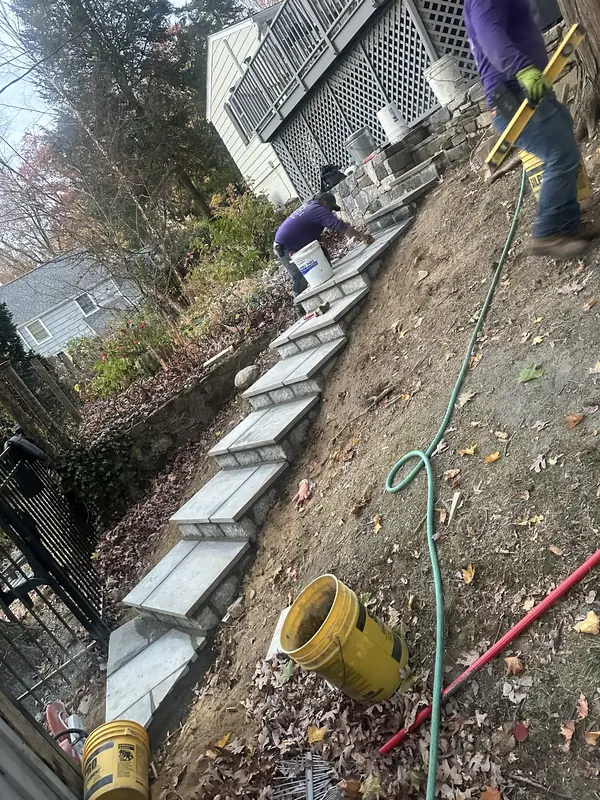
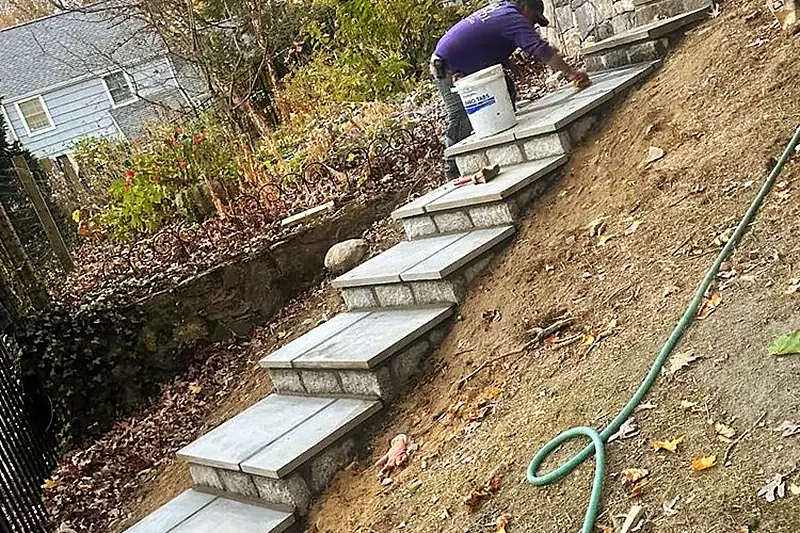
Mortared stone is best for steps, stoops, pillars and walls tied to the house, because those need a fixed, exact surface. The trade-off is that mortar cannot flex, so mortared work needs a poured footing below frost depth that dry-set work does not.
Segmental block is best for a tall wall holding a driveway or a slope, because the system is designed as a unit with its drainage. For height, drainage zones and permits, see retaining wall installation.
Sometimes no wall is the right answer. The same ASLA article notes that a simple slope may do the job with less cut to the land. If a graded bank and plantings solve the problem, Nelson will say so.
Bluestone patios and walkways
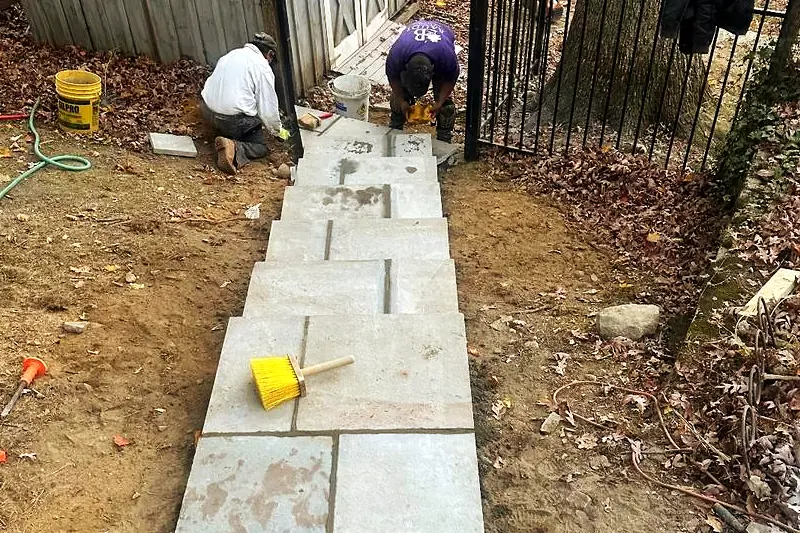
Bluestone is the default for patios and walks here: dense, it takes freeze-thaw well, and it sits comfortably next to a hundred years of existing stonework.
- Thermal finish is best near pools and on steps, because the even, slightly textured surface stays grippy when wet. More on this in pool patios and surrounds.
- Natural cleft is best where you want variation and an older look, because it is the split face of the stone, with more relief underfoot.
- Full-thickness stone is best for sand-set work, because it stays put where thin veneer-cut stone rocks and cracks.
Comparing stone to pavers? Our guide to masonry or pavers for a Westchester patio covers rigid versus flexible under freeze-thaw.
Repair, reset or rebuild
Not every failed surface needs demolition. A patio that has settled in one corner can often be lifted and re-set on a corrected base, using the stone you already own. Steps that shed a tread can take a new tread. Joints that washed out can be repointed or re-sanded.
The first two jobs below are published examples of both: a patio re-set on its own stone, and a stair and wall that needed rebuilding.
What we will not do is cosmetic work over a structural problem. If the base has failed, new joints are makeup on a moving surface. The difference is usually visible from grade: a surface that failed evenly needs joints, a surface that failed in one place needs its base opened.
Old dry-laid farm walls are their own subject: see stone wall repair.
What decides the price of masonry work?
There is no honest single number without seeing the site, because the price of stonework here is mostly set by what happens below the surface. Two patios of identical size can price very differently. What we measure on the walkthrough:
- How much excavation and base the site needs
- Drainage work before the finished surface
- Access: whether a machine can reach, or material is carried by hand
- Stone type: bluestone, fieldstone, segmental block or veneer
- Dry-set versus mortared (mortared adds a footing below frost depth)
- Repair versus new construction
- Steps, walls and patios combined in one scope
Nelson measures and leaves a written scope and price. The walkthrough is free, and the price is in writing before any work starts.
Before anyone digs: two things to know
Utility markout. New York State law requires member utilities to respond to a location request within two business days, not counting the day of submission (Dig Safely New York, digsafelynewyork.com, read September 2026). Build that into your start date.
Permits and frost depth are set by your town. Frost depth for footings is set by your local building department, so ask them for the figure at your address; we do not publish a county-wide number. Retaining wall permit thresholds are also set locally and differ across Westchester villages and Greenwich. We confirm both with your town during the estimate.
Stone and ground under one roof
A masonry job leaves more than stone behind: the lawn the excavator crossed, the bed the wall now shadows, the downspout that has to move. Baudi does the green half of the property as its everyday work, so a masonry job ends with the ground finished. Grade corrected, topsoil back, sod or seed down, plantings in. One scope, and the same phone number if anything needs attention afterward.
A spring check you can do yourself
Once a year, after the ground thaws:
- Lay a straightedge or level across the patio at each corner. Note any spot that has dropped since last year.
- Look at mortared steps for cracks that follow the joints in a stair-step line.
- Sight along the top of each wall. A belly or a lean outward is worth a call.
- After a heavy rain, check where water sits at the base of walls and the low edge of the patio.
Take a dated photo of anything you find. If it has changed by next spring, call us and we will look at it on site.
How we got these numbers
- Weather: NOAA GHCN-Daily records for Westchester County Airport (White Plains), station USW00094745, July 1 2015 to June 30 2025, 3,649 daily records across 10 winter seasons (July to June). A freeze-thaw day is any day with a high above 32F and a low below 32F. Heavy rain days are days with 1 inch or more.
- Soils: USDA NRCS SSURGO via Soil Data Access, survey NY119 (Westchester County). Each map unit's dominant condition, weighted by acres, open water excluded. "Rated soil" means map units with a drainage class, which leaves out urban land, rock outcrop and pits.
- Reviews: 105 public Google reviews of five other Westchester landscaping companies, plus Baudi's own, read in September 2026. Details in the review study.
- Limitations: one airport station in the south-central county; northern Westchester hilltops run colder, and a few days per season are missing. Soil figures are county-wide, not your lot. Review theme counts are a floor: they count only what reviewers chose to write, not what happened.
How the estimate works
- 1Tell us what you need
- 2Walk the property with Nelson
- 3Receive a written scope and price
- 4Schedule the work
Common questions
Not here? Call (914) 486-3682. Someone answers seven days a week.
It depends on excavation, drainage, access, stone type and whether the work is dry-set or mortared. See the list above. Nelson leaves a written price after the walkthrough.
Usually. Walk us to the existing wall and we will look at the stone, color range and joint before quoting. If a true match is not available, we will say so.
Often, yes. Settled sections can be lifted and re-set on a corrected base with the same stone. If the failure is structural we will say so, because new joints over a failed base do not last.
Excavation, base work and dry-set stone run from spring thaw until the ground freezes. Mortared work needs temperatures reliably above freezing to cure. Winter is when we plan and quote.
Westchester County, including Scarsdale, Rye, White Plains, New Rochelle, Harrison, Larchmont, Mamaroneck and Bronxville, and Greenwich, CT.
Related work we do
Most properties need more than one of these. One call covers all of them.
What clients say
Baudi Landscaping holds a 5.0 rating from 22 Google reviews.
I've used Baudi Landscaping for lawn care, masonry, landscaping and snow removal and do not have a single negative to report.
Twenty minutes on site, a written price.
Send a few details and we will come out, measure, and leave you with a written price. No fee, no sales visit, no pressure to sign anything that day.
Prefer to talk? Call (914) 486-3682 or text a photo of the area. Open seven days, 7 AM to 7 PM.
- Phone
- (914) 486-3682
- Hours
- Monday to Sunday, 7 AM to 7 PM
Request received.
Nelson or someone on the crew will call you within 24 hours to set up the walkthrough. If it is urgent, call (914) 486-3682 and you will get a person.