

Snow Removal
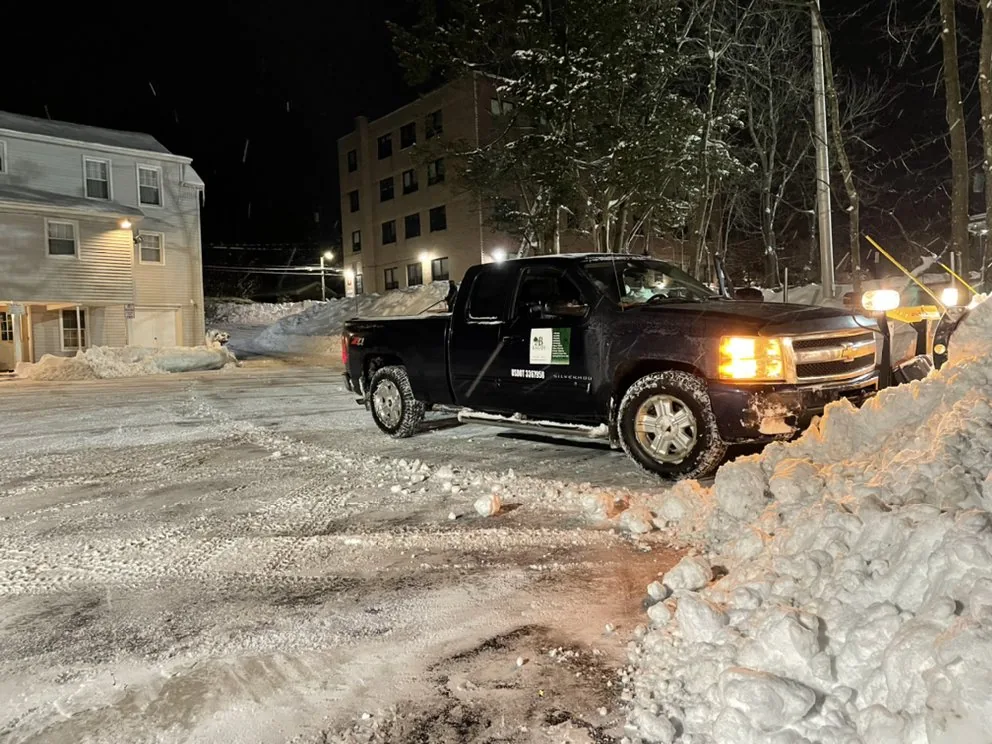
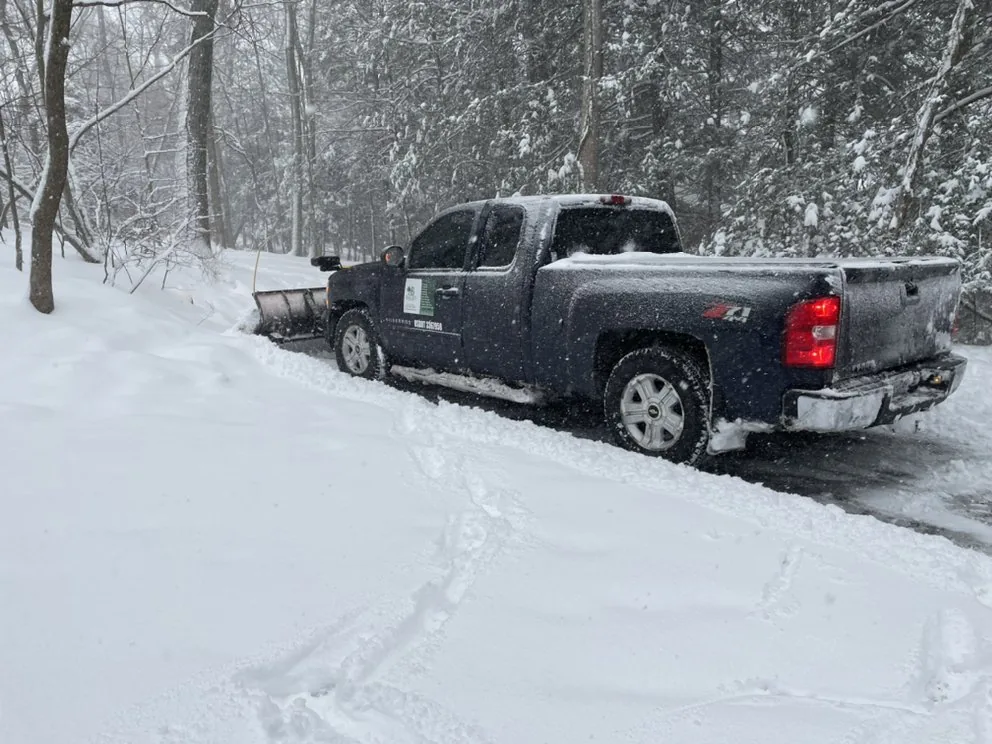
December through March we plow driveways and commercial lots, clear walks, steps and entrances by hand, and treat what we cleared. Seasonal contract or per storm.
Plowing, shoveling and treating, residential and commercial
Snow is a different business from landscaping and we run it that way. Different equipment, different hours, and a route built before the season starts. The crew is the same crew, and nothing gets handed to a subcontractor for the winter.
On a house that means the driveway plowed, the apron opened back up after the town truck banks it shut, and the walks, steps and entrance cleared by hand or with a blower. A plow does not do steps. Somebody has to shovel them, and that is usually what decides whether anyone reaches the door.
On a commercial property it is the lot, the fire lanes, the dumpster approach and the sidewalk along the frontage, worked overnight and before dawn ahead of the business day.
A snow account covers:
- Driveway plowing, including the apron the town plow closes back up
- Walkways, steps, stoops and entrances cleared by hand or blower
- Commercial lots plowed and stacked, fire lanes and dumpster approaches kept open
- Sidewalk runs along a commercial frontage
- Salting and sanding on cleared surfaces
- Pre-treating ahead of a forecast storm where it is worth doing
- Return passes through a long storm instead of one push after it ends
Trigger depth, seasonal contract and per storm
Every snow contract has a trigger depth. It is the accumulation at which the crew rolls without being called. Two inches is the usual number on a residential driveway. Commercial lots are often set lower, because a lot with an inch of packed snow across it is a lot people are walking on.
What matters is what a trigger does not do. Below it, nothing happens automatically. A half-inch event that glazes over is not a plow event at a two-inch trigger, which is why ice treatment is written into the contract separately from plowing. If you want the property touched at every event regardless of depth, say so while we write the scope.
Trigger also resets during a storm. Eight inches over eighteen hours is not one visit. The crew works through it as it accumulates, because plowing eight inches in one pass pushes a wall of snow that has to go somewhere and does not scrape close to the surface.
Seasonal and per storm are both reasonable arrangements, and which is better depends on a winter nobody can see in October. Seasonal is a fixed commitment that buys position on the route, since per-storm work gets fitted in around contracted accounts. Per storm covers only what happened, which is the better side of the trade in a light year.
Where the snow gets stacked decides what the driveway looks like Thursday
Snow has to go somewhere, and the pile is not finished when the plow leaves. This is the detail that separates a crew that has plowed a property before from one that has not.
Push a pile to the uphill side of a sloped driveway and the first sunny afternoon melts the bottom of it. That water runs down across the surface just cleared, and when the temperature drops after dark it freezes into a sheet. The driveway gets cleared and then ices anyway, from snow the crew put there. So we stack downhill of the running surface where the grade allows, or off a side that drains away from the drive.
The rest of the stacking follows the same thinking. Piles do not go on a catch basin, because that is where the melt needs to leave, and they do not block the sight line pulling onto the road. On a commercial lot they stay out of the row nearest the door and off any line where runoff crosses the walkway. They do not go on beds and shrubs either. A season under a salted plow pile is how foundation plantings die.
Salt, sand, and what they do to the stone underneath
Rock salt, sodium chloride, has a temperature limit. It works well down around 20 degrees Fahrenheit, slows badly below that, and in the teens it is mostly sitting on the ground. Throwing more rock salt at a surface too cold for it melts nothing. It only puts more chloride on your masonry and into the soil. Calcium chloride keeps working far colder, and it pulls moisture from the air to start melting instead of waiting on sun. Sand melts nothing at all. Sand is traction, and in a deep cold snap on a steep drive traction is what is actually available.
Now the part a snow-only outfit has no reason to bring up. Chlorides are hard on the things we build. Repeated exposure drives scaling and spalling on concrete and mortar joints, showing up as a surface that goes rough and flakes rather than a crack you can point at. Concrete pavers hold up better than poured concrete, but the joints and the edge restraint still take it. Plantings along a driveway edge take it twice, as spray off the plow and as runoff into that soil at every thaw.
We built a lot of these patios, walls, stoops and driveway aprons ourselves, which is a useful thing to have on the other end of the shovel. We are not going to bury a bluestone stoop we set in rock salt. Where a surface has something to lose, sand or a lighter calcium chloride application makes more sense.
Recent work
How the estimate works
- 1Tell us what you need
- 2Walk the property with Nelson
- 3Receive a written scope and price
- 4Schedule the work
Common questions
Not here? Call (914) 486-3682. Someone answers seven days a week.
It comes down to the length and slope of the drive, how much turnaround room there is, how many feet of walk and how many steps have to be cleared by hand, the size and layout of a commercial lot, where snow can be stacked, the trigger depth you want, whether salting or sanding is included, and whether you go seasonal or per storm. Nelson walks the property before the season and writes it out. The estimate is free. For commercial sites, our guide to commercial snow contracts covers response windows, ice management and the service records that matter after a claim.
It is the accumulation at which we come out without you calling. Two inches is typical on a residential drive and commercial lots are often set lower. Below the trigger, plowing does not happen automatically, which is why ice treatment is written as its own line. If you want the property touched at every event no matter the depth, tell us and we will write it that way.
Commercial accounts are worked overnight and before dawn, ahead of the business day, and the route is ordered around that. We will not put a clock time in writing, and nobody being straight with you will. A storm still dropping at 6 AM is a storm we are still working. What we will tell you is where your lot sits on the route and how many passes the contract calls for.
Related work we do
Most properties need more than one of these. One call covers all of them.
What clients say
Baudi consistently does an awesome job for us. They are very reliable and efficient, and Nelson is great to work with.
Consistently reliable, on schedule every week for mowing and maintenance. My lawn looks neat, healthy and professionally cared for.
Free on-site estimate
Twenty minutes on site, a written price.
Send a few details and we will come out, measure, and leave you with a written price. No fee, no sales visit, no pressure to sign anything that day.
Prefer to talk? Call (914) 486-3682 or text a photo of the area. Open seven days, 7 AM to 7 PM.
- Phone
- (914) 486-3682
- Hours
- Monday to Sunday, 7 AM to 7 PM
Request received.
Nelson or someone on the crew will call you within 24 hours to set up the walkthrough. If it is urgent, call (914) 486-3682 and you will get a person.