


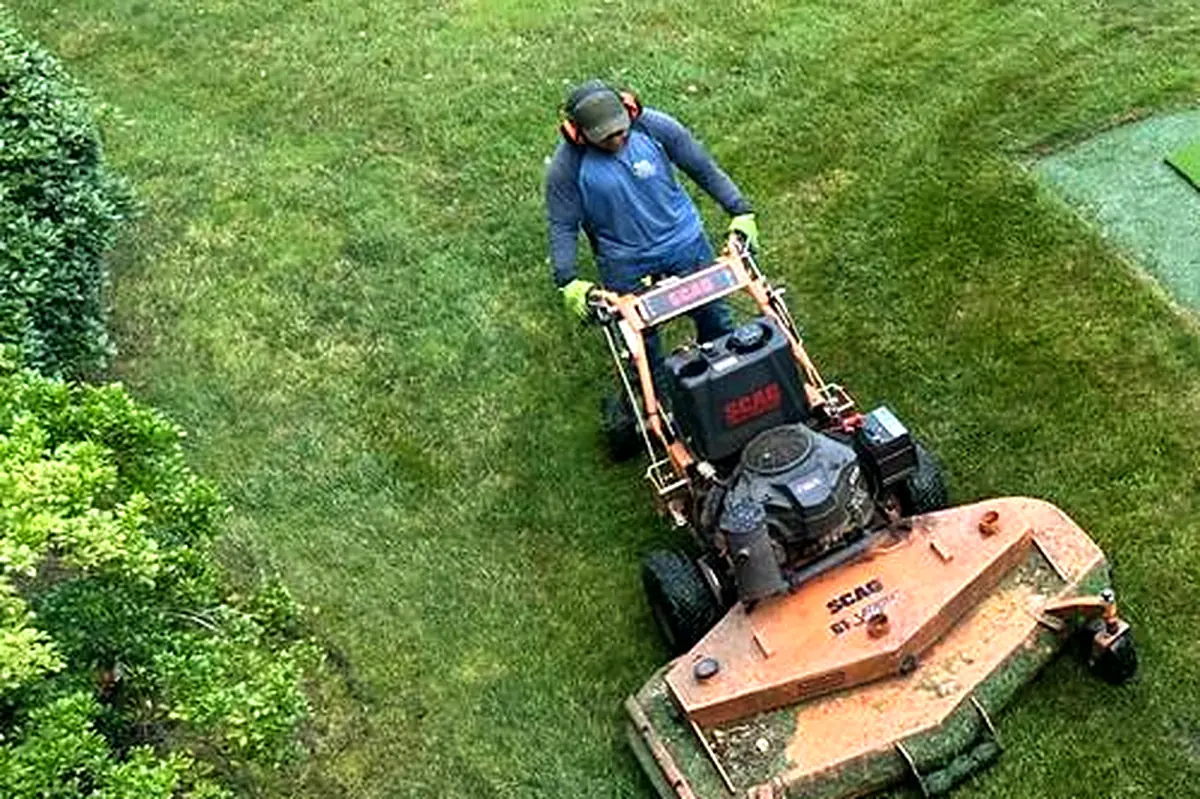
Commercial and HOA
Contract grounds care for homeowner and condominium associations, office parks, retail centers, and owners running several properties at once. One scope, one contact, and the same crew on the site every week.
What a board or a managing agent is actually buying
A homeowner hires a landscaper because they want the yard to look good. A board hires one to get the subject off the agenda. Those are different purchases and they get judged on different things. Nobody at a meeting is going to praise the mowing. They will absolutely raise it when the mulch was late, when a resident called twice and heard nothing, or when the certificate of insurance in the file expired in March.
So the deliverable is a scope written tightly enough that nobody is arguing about interpretation in month seven, a schedule predictable enough that residents stop calling the manager, one person who answers and can commit to an answer, paperwork that arrives before it is chased, and documentation that stays with the association when the board turns over.
We would rather write more detail into the scope than less. Vague contracts do not save anyone money. They move the argument to April.
What a properly written grounds contract nails down:
- Visit frequency for each service, and which services are included in a visit versus authorized separately
- Mowing height by season, the edging and trim standard, and how hard surfaces are blown down
- The number of mulch applications and the window each one falls in, by month rather than by season
- Turf treatment rounds, and who holds the applicator license for anything requiring one
- A pruning calendar by plant category, since shearing a spring-flowering shrub in March removes the flowers and somebody notices
- Irrigation start-up, mid-season checks and winterization where the property has a system
- Common area versus limited common area versus unit-owner responsibility, drawn on a site map so it stops being a conversation
- The snow section with its own trigger, priority order and treatment obligations, written separately from plowing
- Storm debris and off-cycle work, and the change-order procedure for approving it
- Insurance requirements, certificate holder and renewal date
One contact, and what that is worth when a resident is upset
Nelson Bautista answers the phone. On a single-family property that is a pleasant detail. On a ninety-unit association it is the difference between a two-minute call and a line item on the next agenda.
The usual failure of an association landscape contract is structural rather than technical. The salesperson is not the account manager, the account manager is not on site, the crew changes week to week, and nobody standing on the property has authority to agree to anything. A resident complains about a shrub. It goes to the managing agent, the agent emails the office, the office texts a foreman who was not there last week, and three weeks later the shrub is exactly as it was. The work was never the problem.
What we run is small on purpose. The person who priced the property is on the property. The crew is Baudi's own and it is the same faces on the same day, so they learn where the irrigation heads sit, which curb the mower catches, and which bed the mail carrier walks through. We will walk the site with the manager or a board member on whatever cycle you want, and the notes go in writing.
That last part matters more than it sounds. Boards turn over every year or two. The scope, the site map, the walk notes and the schedule belong to the association, not to whoever happened to be president when the contract was signed. A new board should be able to open the file and know exactly what it is paying for.
Scheduling across several properties
A managing agent with a portfolio has a different problem from a single site. Every property wants the same crew on the same Tuesday, and a contractor who solves that by adding a truck of unfamiliar people has not solved it.
Routes get built geographically and every property gets a fixed day. Fixed days are worth more than they read on paper. Residents plan around a known mow day. Trash pickup, deliveries, the pool service and the window washers stop colliding with a crew and a set of blowers. And when a week of rain pushes Tuesday to Thursday, the manager hears it from us before the first resident asks.
Seasonal work goes on a calendar rather than happening when somebody remembers it. Mulch in this window, spring pruning in that one, aeration in early fall, so in February an association already knows what April looks like and can budget it. Start times and access get set per property, because the constraint differs everywhere. Mowing under occupied bedroom windows at seven in the morning generates complaints regardless of how good the cut is. Retail frontage gets done before the doors open. Parking lots get worked in sections around resident vehicles rather than expecting fifty people to move their cars. None of that is complicated. It has to be agreed once, in writing, instead of relitigated every spring.
Snow and ice: priority order, documentation, liability
Winter is where a commercial contract earns or loses its renewal, and it is a different obligation from clearing a driveway. Our snow removal page covers plowing, treatment and the seasonal-versus-per-storm question generally. What follows is what changes when the property is an association or a business.
Priority order is written into the contract and agreed before the season: which entrances open first, the fire lanes, the walkways to unit doors, the mail kiosk, the dumpster enclosure, the accessible spaces and the ramps, and in what sequence. A trigger on a commercial site is normally set lower than on a residential drive, because an inch of packed snow across a lot is a surface people are walking on, and walkway clearing and ice treatment are written as their own obligations rather than folded into plowing.
Then documentation, which almost nobody talks about and which is the reason a lot of associations change contractors. Slip-and-fall claims arrive months after the storm, and what defends the association is a record. So each event is logged: date, time on site, time off, conditions and accumulation, which areas were cleared, and what material went where. Those logs go to the manager and into the file. If a claim comes in the following August, the answer is a document rather than somebody's memory.
A pre-season walk goes with it. Before anything is buried we mark hydrants, catch basins, curb ends, bollards, islands, irrigation heads and bed edges, and agree stacking areas on the site map. Where snow is piled decides whether a lot refreezes. A pile uphill of a walkway melts across it every sunny afternoon and glazes it after dark, a pile on a catch basin blocks the only route the melt has out, and a pile in the wrong row takes out visitor parking for the winter or buries a hydrant.
We will be plain about the limits, because you should be suspicious of anyone who is not. No contract makes a surface ice-free and nothing anybody applies prevents a refreeze after a thaw. What is contracted is what the crew does: the passes, the sequence, the materials and the record of it. We do not put a guaranteed clock time in writing, and a proposal that does is telling you something about the person who wrote it.
Recent work
How the estimate works
- 1Tell us what you need
- 2Walk the property with Nelson
- 3Receive a written scope and price
- 4Schedule the work
Common questions
Not here? Call (914) 486-3682. Someone answers seven days a week.
By the property, after a walk. What moves it: total turf area and how cut up it is, the length of bed line and how much shrub mass there is, the footage of walkway and curb edged and blown every visit, tree count and leaf volume in the fall, how much of the work happens around parked cars or occupied units, the service frequency the association wants, and whether snow sits in the same agreement. We price to your written specification if you have one, so the bids compare directly.
Yes. We are licensed and insured and carry USDOT #3367958. Certificates are issued by our carrier to the managing agent before the first visit, with the certificate holder and additional insured language your contract calls for, and they are reissued at renewal without you having to ask. Send us the insurance exhibit from the contract and we will confirm in writing that we meet it before you award anything.
Nelson, on the same number the estimate came from. There is no account manager layer between the person you call and the person on the property, which is the whole reason a small contractor is worth considering for a site this size. If something is wrong we would rather hear it the day it happens than read it in the minutes.
Related work we do
Most properties need more than one of these. One call covers all of them.
What clients say
Baudi consistently does an awesome job for us. They are very reliable and efficient, and Nelson is great to work with.
Consistently reliable, on schedule every week for mowing and maintenance. My lawn looks neat, healthy and professionally cared for.
Free on-site estimate
Twenty minutes on site, a written price.
Send a few details and we will come out, measure, and leave you with a written price. No fee, no sales visit, no pressure to sign anything that day.
Prefer to talk? Call (914) 486-3682 or text a photo of the area. Open seven days, 7 AM to 7 PM.
- Phone
- (914) 486-3682
- Hours
- Monday to Sunday, 7 AM to 7 PM
Request received.
Nelson or someone on the crew will call you within 24 hours to set up the walkthrough. If it is urgent, call (914) 486-3682 and you will get a person.