

Outdoor Kitchens
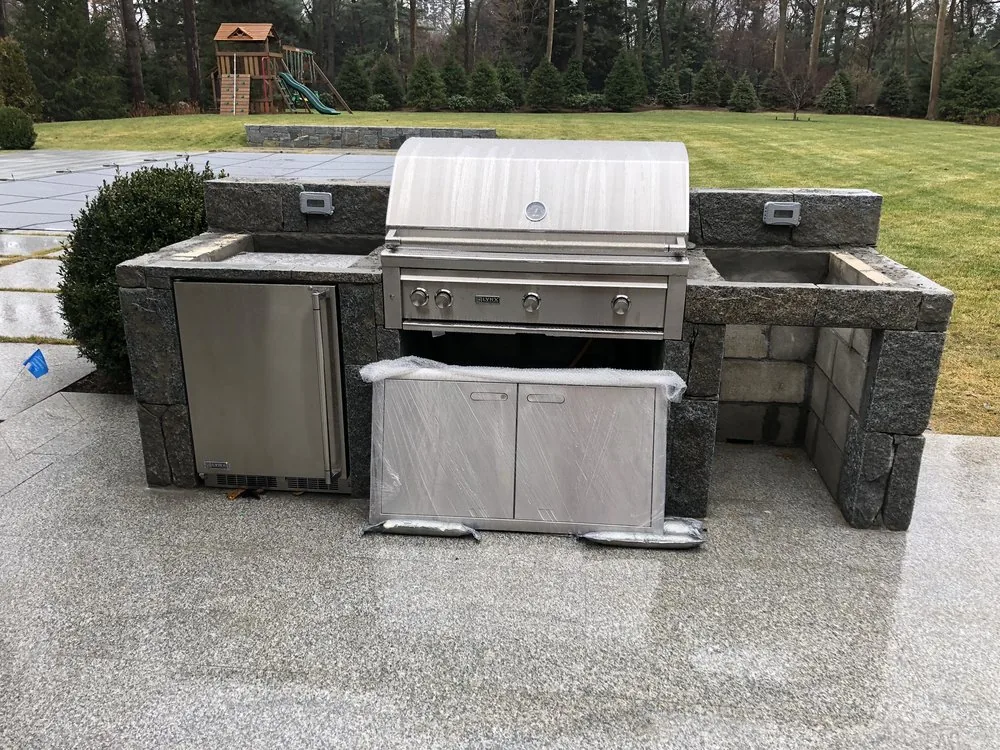
A grill island, a counter run, a fire pit or a full outdoor fireplace are masonry structures with appliances set into them. What decides whether they are still square and tight in ten years is what was poured underneath and what was coordinated before the first block went up.
A grill island is a building, not a piece of furniture
The part you look at is veneer and a countertop. Behind that face is a core, and the core carries everything else. Baudi builds cores in block, because setting block is what this crew does most weeks of the year.
Layout comes first. Where the cook stands, and whether that position blocks the path to the door. Which way the wind carries smoke, because a grill venting into the seating is a mistake nobody forgives. How far the hot appliances sit from the house wall, from a wood post, from the underside of a deck. Where the propane cylinder and the trash live, since those two decide whether the island is pleasant to use or a daily annoyance.
Appliance openings are dimensioned to the units you are actually buying. Every drop-in grill, side burner and access door has a rough opening published by its manufacturer, and the core is built to that number, which means the appliances get chosen before the block goes up. A grill that arrives two inches wider than its hole is a problem with no cheap answer once the counter is set.
What tends to go into one:
- A built-in grill framed to the maker's rough opening, with clearance held to anything combustible behind or beside it
- Counter runs at working height, plus a raised bar section where stools are planned
- A side burner, pizza oven or smoker, each with its own venting and clearance requirements
- Stainless doors, drawers and a trash pull-out, so the space under the counter is usable rather than a void
- An under-counter refrigerator, which wants a dedicated circuit, side ventilation and a route for condensate
- Vented low storage for a propane cylinder on properties not fed by natural gas
- A sink run where water can be brought over and, more to the point, drained back down before the first freeze
- A seat wall tying the island into the patio instead of leaving it stranded
The footing under a fire feature is a different problem from a patio
A patio is a field of separate units on a compacted base. It is meant to flex a little, and a unit that moves can be lifted and reset. How that base gets built is covered on our paver installation page and there is no reason to repeat it here.
A kitchen island or an outdoor fireplace is the opposite kind of object: rigid, heavy, and landing all that weight on a small footprint. A masonry fireplace and chimney can run to several tons standing on fifteen square feet. Set that on a patio base and it will not ride the winter the way the patio does. It goes down, it takes the surrounding stone with it, and because the structure is rigid the movement shows as a crack through the firebox or a chimney visibly out of plumb against the house line.
So these get a poured footing carried past the frost line, which in this county means digging on the order of four feet, bearing on undisturbed soil rather than fill. The footing goes in first and the patio is built up to it afterward, with the field cut around the finished structure. That order is why we raise the kitchen while the patio is still being designed, even when it will not be built for two more years. Adding an island later is real work: pavers up, base opened, footing dug through it, structure built, field closed back around it.
A fire pit is the lighter case. A dry-laid ring of wall block or cut stone puts little enough load on the ground that it can sit on a properly compacted patio base and move with it. A mortared pit is rigid again and wants a footing of its own. Either way the inside face is firebrick or a steel insert, because ordinary block and standard mortar spall when they take direct flame, and the floor has to drain. A pit that fills with rain and then freezes comes apart from the inside.
Gas, electric and water get settled before the block goes up
This is where outdoor kitchens go wrong, and it is a coordination problem rather than a construction one. Baudi does the masonry. The gas line and any line-voltage circuit are the work of a licensed plumber and a licensed electrician, scheduled around our build rather than performed by us. What we own is making sure their work has somewhere to go.
That means sleeves and chases built in while the structure is open. A gas sleeve running under the patio from the meter or the tank. Conduit to the outlet locations and a separate run for the refrigerator. A stub for a sink supply and, more importantly, a drain with a low point that can be blown out in November, since plenty of outdoor sinks split their first winter because nobody put a shutoff anywhere reachable.
Timing is the whole argument. Running a sleeve while the excavation is already open is a length of pipe. Running the same line after the stone is set means opening the field, trenching, and rebuilding the base and surface over it. If the property is on propane rather than natural gas, tank location and line sizing need settling before the island is positioned. And if you want the counter or the steps around it lit, the low-voltage wire wants to go in at the same moment. Our landscape lighting page covers what that gets you.
Counter material, and what a winter here does to it
The number that matters on an outdoor counter is absorption. A porous slab pulls water into itself, the water freezes, and the surface flakes and pits from above. Everything else about the choice is secondary.
Granite is the usual answer for a reason: dense, low absorption, indifferent to a hot pan. Full-thickness bluestone reads native against an older house and gives a thermal finish that grips underfoot, but it takes in more water than granite, so it will patina and it benefits from a penetrating sealer. Porcelain slab is dense and holds colour, though edge detail and support underneath need thinking about. Cast concrete counters can look excellent and are the most likely to hairline crack outdoors. Marble and limestone are the ones we will talk you out of, because they etch when something acidic lands on them, which outdoors means a dropped drink or a squeezed lime.
Two details get skipped. Stone is strong in compression and weak in bending, so a bar overhang past roughly a foot wants steel or a corbel under it, and an unsupported nose is where a counter eventually snaps. And the surface gets a slight fall built in, away from the grill and the doors, so rainwater leaves rather than standing in front of the appliances and freezing in the seam.
How the estimate works
- 1Tell us what you need
- 2Walk the property with Nelson
- 3Receive a written scope and price
- 4Schedule the work
Common questions
Not here? Call (914) 486-3682. Someone answers seven days a week.
We do not publish a number, because two islands the same length can be very different jobs. What moves it: the length of the counter run, how many appliances go in and whether you are supplying them, the veneer and counter materials, whether gas and power already reach that side of the house or have to be trenched across the property, whether an existing patio has to be opened and rebuilt around the structure, and how equipment reaches the back yard. Nelson walks it and puts a written scope in your hands. That visit is not billed.
Yes. The pavers over the footprint come up, the base is opened, a footing is dug past frost and poured, the structure goes up on it, and the field is reset around the finished work. Done properly nobody can see where the patio was opened. It is more work than building the two together, which is the only reason we raise the kitchen while a patio is still being designed.
No. We build the structure and we build in the sleeves, chases and box locations while it is open. The gas connection and any line-voltage circuit are done by a licensed plumber and a licensed electrician, scheduled around our days so nothing has to be reopened. We tell you plainly which part of the job is ours and which is theirs before you sign anything.
Related work we do
Most properties need more than one of these. One call covers all of them.
What clients say
I've used Baudi for lawn care, masonry, landscaping and snow removal and do not have a single negative to report. Highly recommend Nelson and his team.
Always taking good care of everything and doing the best job. Attentive, and answers all my questions.
Twenty minutes on site, a written price.
Send a few details and we will come out, measure, and leave you with a written price. No fee, no sales visit, no pressure to sign anything that day.
Prefer to talk? Call (914) 486-3682 or text a photo of the area. Open seven days, 7 AM to 7 PM.
- Phone
- (914) 486-3682
- Hours
- Monday to Sunday, 7 AM to 7 PM
Request received.
Nelson or someone on the crew will call you within 24 hours to set up the walkthrough. If it is urgent, call (914) 486-3682 and you will get a person.