

Pool Patios
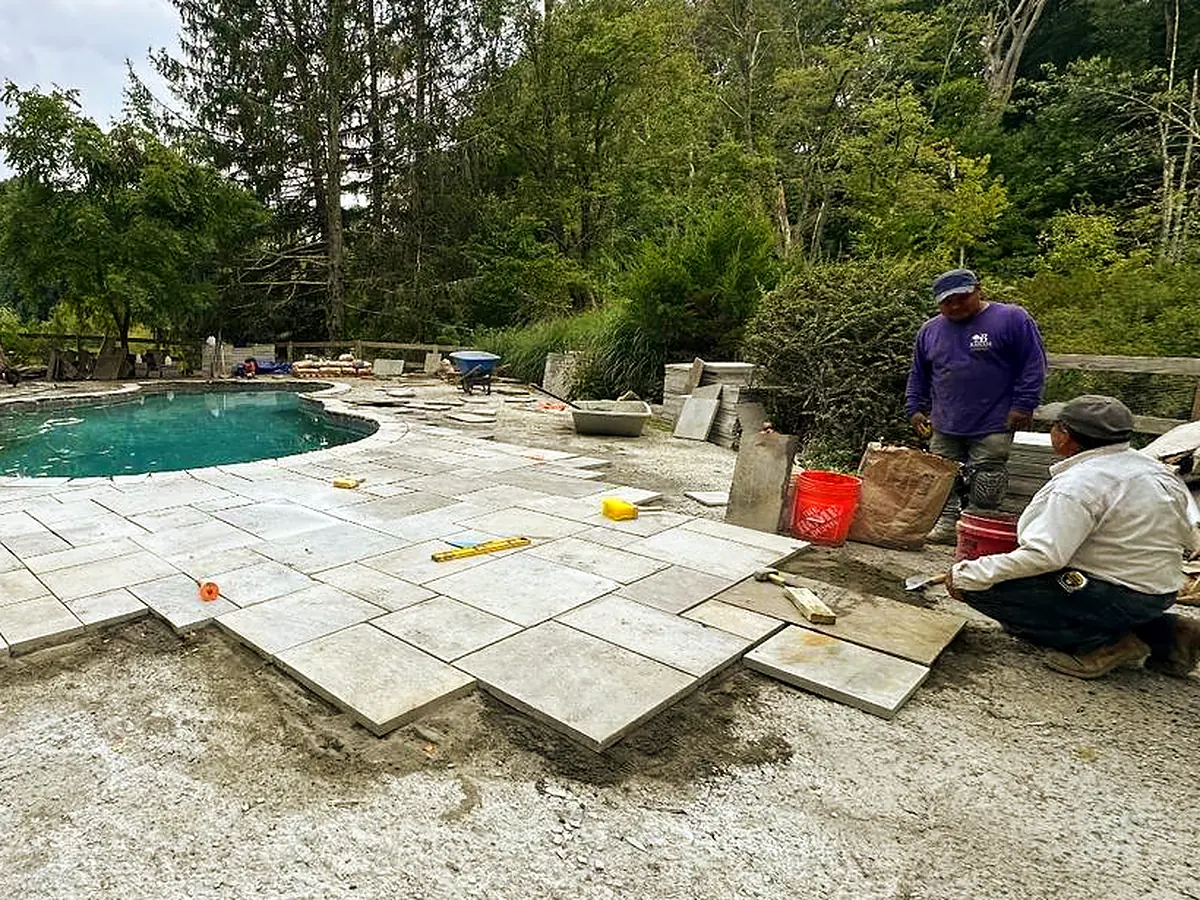
A pool deck has to shed water away from the shell, stay walkable on bare wet feet, and sit against a rigid structure that does not move the way the ground around it moves. Those are not the problems a patio in the middle of a lawn has.
Coping is the piece the rest of the deck is built around
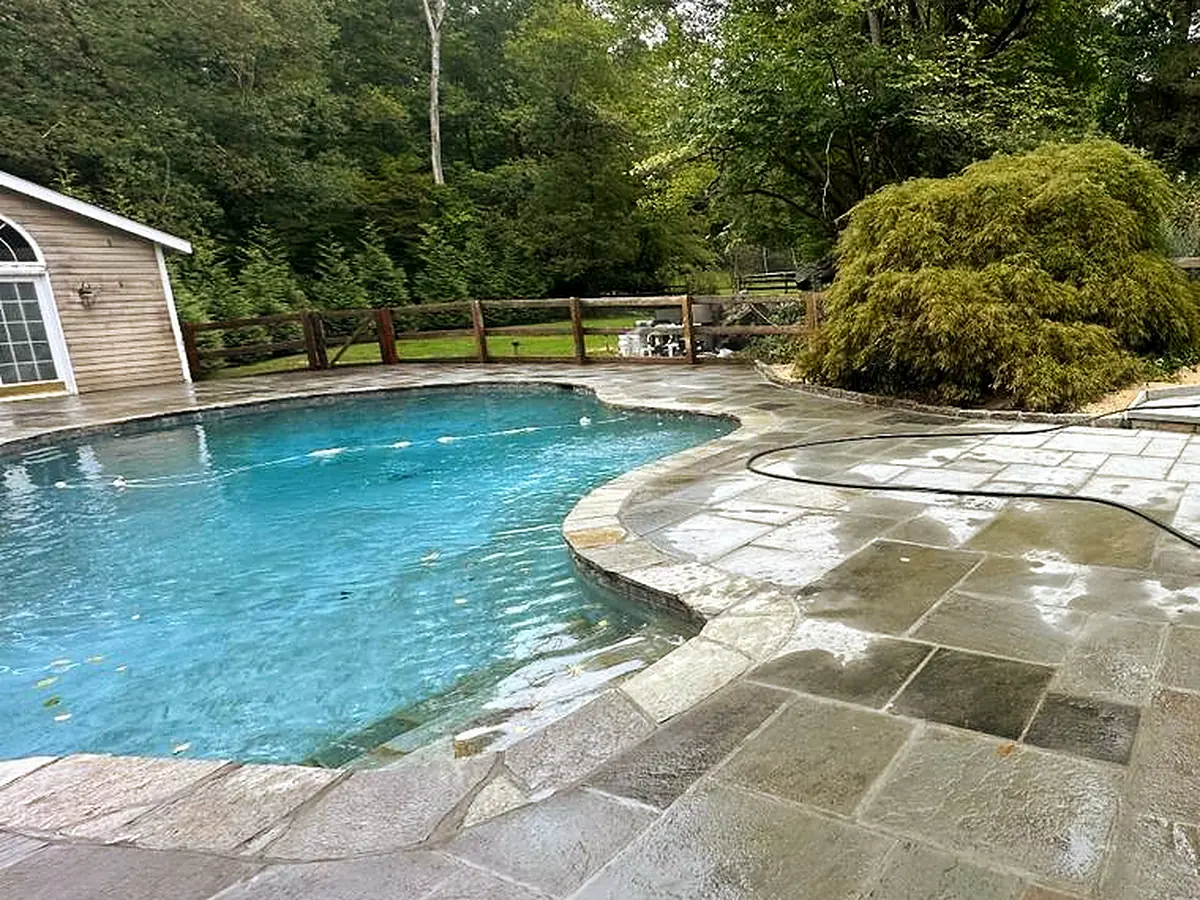
Coping is the capping course sitting on the upper edge of the pool wall. It hides the tile line, gives a swimmer something to grab and push off, and takes every splash, every elbow and every winter.
The profile is a real decision rather than a finish choice. A bullnose rolls the edge over and is the kindest thing to hands, knees and shins, which matters when children use the pool. A cantilever profile carries the deck material out over the shell for a cleaner line. A square-edge cap looks sharp and behaves that way against a shin. Full-thickness bluestone reads native here and is the one most often specified on the older houses around Bedford and Katonah.
What all of them share is that coping is mortared and fixed to the pool structure while the deck behind it is not. It is the one rigid element in an otherwise flexible surface, which is why it deserves its own line on an estimate. It is set to pitch away from the water so rain and splash-out leave the pool area rather than running back across the tile line, carrying grit and whatever was on the deck into the water.
Loose coping is the most common pool masonry call we get. A stone that rocks underfoot means the mortar bed beneath it has failed and water is getting behind the cap. Fixing it means taking the stone up, cleaning the old bed off down to sound material, and resetting it. Buttering fresh mortar over a failed joint hides it for one season.
The joint between coping and deck is where pool patios fail
Two materials, two behaviours. The coping is locked to a concrete structure that does not move. The deck is a field of units on a base that settles slightly and shifts with frost. Join those rigidly and something gives, and what gives is the mortar, the coping bed, or the first course of deck stone.
So that joint is built to move. Backer rod down the gap and a flexible sealant over it, not mortar and not joint sand. It stays slightly compressible for the life of the deck, and it is a maintenance item rather than a permanent detail, so expect to have it cut out and redone every several years. A crew that fills that gap with mortar because it looks neater on handover day has built the crack in.
Excavation next to the shell needs its own restraint. On a vinyl-liner pool the wall panels are held partly by the ground behind them, so digging hard against a panel can bow it while the pool is still full. The deck base is built up to the structure and the last band next to it is hand-worked rather than machine-dug. Compaction follows the same rule: the plate compactor does its work out in the field and that last strip is hand-tamped, because sustained vibration against a wall or a liner track is one of the ways a pool gets damaged during a hardscape job.
The general build-up under the field, the excavation depth, the lifts and the bedding layer, is described on our paver installation page and nothing about it changes at a pool. What is pool-specific is everything within about three feet of the water.
Water has to leave, and it has to leave away from the shell
Three separate volumes arrive on a pool deck: rain falling on it, splash-out coming over the coping, and whatever the yard above sheds toward the pool. All three want a route out that does not go back into the water and does not sit against the structure.
Pitch handles most of it. The deck falls away from the coping on every side and the perimeter falls to somewhere that can take it. The awkward case is a deck that is boxed in, which describes a lot of Westchester pools cut into a hillside with a wall on the high side, a house on one side and a fence on the other. With no free edge to run off, pitch alone stops being enough, and the deck gets a channel drain along its low line or inlets set flush into the field, tied to a line with a discharge point that actually exists.
Standing water does more harm here than on any other patio. It sits against the coping joint, works into the bond beam and freezes there. Water running the wrong way, back over the coping, drags grit into the pool where it passes through the filter and abrades the finish. And in January the low spot on the deck is the sheet of ice everybody walks on in April when the cover comes off.
The soil around a shell deserves the same attention as the soil behind a wall. Saturated ground presses on a pool structure the way it presses on anything buried in it, and a hillside draining across the pool area is a problem to solve before the deck goes down rather than after. Where that is what is really going on, it is a grading job first and a patio job second.
Wet stone, bare feet, and slip resistance
This is the only hardscape on a property that people cross wet, in a hurry, with nothing on their feet. It changes what is worth specifying.
Texture gives grip, not sealer and not colour. Thermal-finish bluestone, where the surface has been flamed open, is the regional default around pools for exactly that reason, and natural cleft flagging works on the same principle. Honed and polished stone are pleasant dry and unforgiving wet, and a smooth-faced cast paver that looked good in a showroom can be worse than either. If a sealer goes on at all it should be a penetrating product rather than a film, because some gloss sealers turn a safe surface slick, and we wait a season regardless so efflorescence can weather off first.
Surface temperature is the complaint we hear most and the one homeowners did not anticipate. A dark charcoal paver in full August sun is not a barefoot surface, and there is no fixing it afterward short of replacing the field. Lighter stone stays materially cooler. Where somebody wants the darker look, the better move is to keep it off the sun-facing run between the door and the water.
The rest is edge detail. Bullnose on step nosings as well as coping, and no sharp arris where people push off the wall. Joints in a splash zone are worked harder than anywhere else on a property, so polymeric sand there needs redoing on a shorter cycle, and on wide-jointed natural stone we will sometimes set an open swept joint instead precisely so it drains rather than traps.
Recent work
How the estimate works
- 1Tell us what you need
- 2Walk the property with Nelson
- 3Receive a written scope and price
- 4Schedule the work
Common questions
Not here? Call (914) 486-3682. Someone answers seven days a week.
It depends on the site more than on the square footage. What moves the number: how much deck there is, the material, whether an old concrete deck has to be broken out and hauled away, how much coping is being reset or replaced, whether the surrounding grade sends water into the pool area and has to be corrected, how many steps and walls are involved, and how equipment reaches a fenced back yard. Nelson comes out, measures and writes it down. There is no charge for that visit.
The field, yes. The coping is a separate question and it is worth answering before the deck is built rather than after. If coping stones are loose or the bed under them has gone, resetting the deck and leaving the coping is the wrong order, because the coping work reopens the joint you just finished. We look at both together and price them as two lines so you can see what each one is.
Something with texture and something light. Thermal-finish bluestone is the usual answer here, since the flamed surface grips when wet and the colour stays cool enough to stand on in August. Natural cleft flagging behaves the same way. Polished and honed surfaces are slippery wet, and dark pavers get uncomfortably hot in full sun. That heat question is the one homeowners tell us afterward they wish somebody had raised.
Related work we do
Most properties need more than one of these. One call covers all of them.
What clients say
I've used Baudi for lawn care, masonry, landscaping and snow removal and do not have a single negative to report. Highly recommend Nelson and his team.
Always taking good care of everything and doing the best job. Attentive, and answers all my questions.
Free on-site estimate
Twenty minutes on site, a written price.
Send a few details and we will come out, measure, and leave you with a written price. No fee, no sales visit, no pressure to sign anything that day.
Prefer to talk? Call (914) 486-3682 or text a photo of the area. Open seven days, 7 AM to 7 PM.
- Phone
- (914) 486-3682
- Hours
- Monday to Sunday, 7 AM to 7 PM
Request received.
Nelson or someone on the crew will call you within 24 hours to set up the walkthrough. If it is urgent, call (914) 486-3682 and you will get a person.