

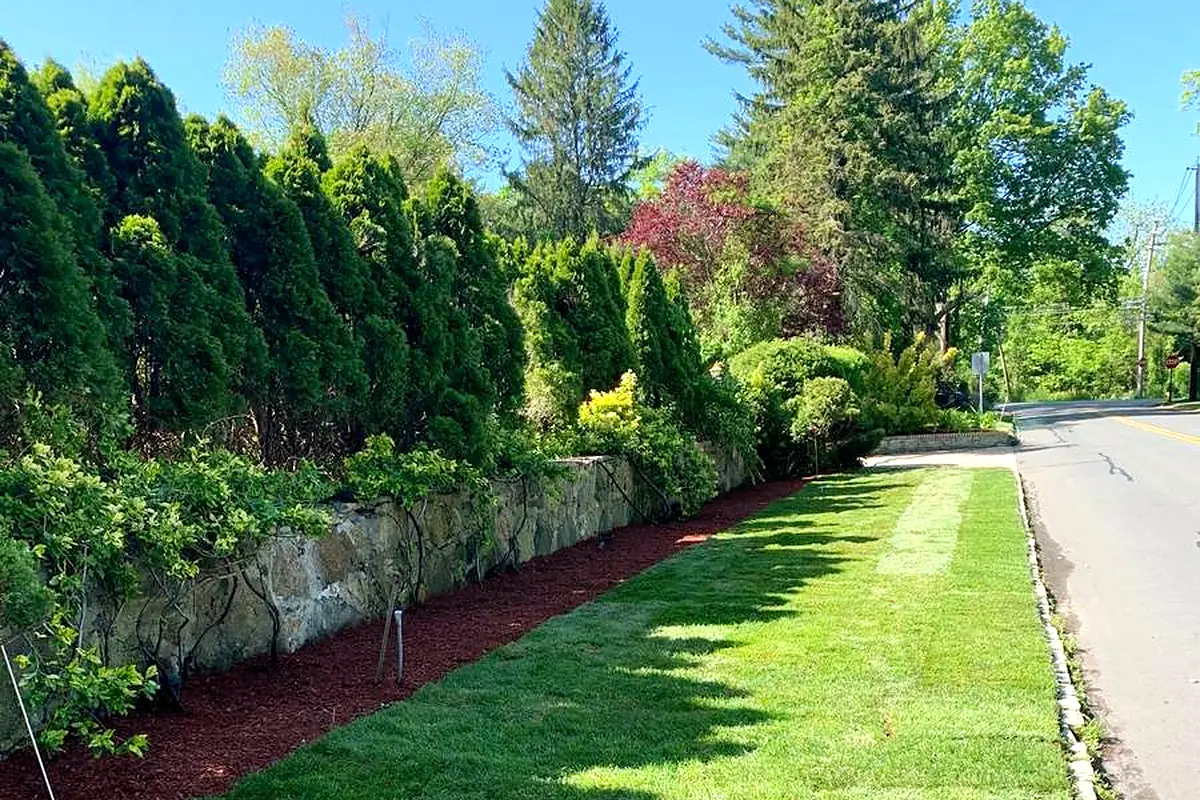
Fall Clean-Up Services in Westchester County and Putnam
Leaves and debris off the lawn, beds and walkways, gutters cleared after the drop, beds cut back and edged, and a final cut before dormancy. One job, booked for the fall, finished before the ground freezes.
One job with a start and an end
A fall clean-up is a package, not an account. We start somewhere in October, work the property in rounds as the canopy comes down, and finish in December with the lawn cut short for winter, the beds cut back and edged, the gutters clear and every bag and tarp of debris hauled off site. Then we are gone until spring. There is nothing to cancel and nothing that rolls over.
You do not need to be on our weekly lawn service to book one. A good share of the properties we clean up in November we have never mowed.
Everything leaves the property. A leaf pile parked against a stone wall or a foundation stays wet all winter and holds that moisture against whatever it is touching.
A full clean-up covers:
- Leaves and debris cleared off the lawn, beds, walkways, patios, driveway and the base of the walls and fence lines
- Everything hauled off site, bagged or tarped, not stockpiled in a corner of the property
- Beds cut back, weeded and re-edged so the bed lines hold through winter
- Gutters and downspouts cleared once the leaves are actually down, and flushed to prove they drain
- A final cut at the right height going into dormancy
- Hard surfaces blown down clean on the last visit
Why it takes passes, not one visit
The canopy in northern Westchester does not drop all at once, and this is the single thing that decides whether a clean-up worked. Maples, ash and birch let go through the middle and back half of October. The oaks hold weeks longer, often into the back half of November, and then drop most of their load inside a week or two once a hard wind gets at them. Beech and some young oaks will hang on to brown leaves right through the winter.
So one visit in early November is not a fall clean-up. It is a clean lawn for about three weeks and a property buried again by December. On a wooded lot we plan rounds instead. An early pass takes the maple drop off turf that is still growing, and the final pass goes in after the oaks have finished. That last one is the pass that has to happen.
How many rounds a property needs comes down to what is growing on it and what is growing next door. An open lot in Pleasantville with two ornamental trees can be one visit and done. A place off Guard Hill Road under mature oaks, with the neighbor's canopy feeding it too, is realistically three. Nelson walks it and tells you which one you have.
Hauling leaves off versus mulching them back in
Leaves either get mulched back into the turf or hauled off the property, and the amount of canopy overhead decides which. Mulch-mowing shreds a light, dry layer into the lawn, where it breaks down over the winter and feeds the soil. Nothing leaves the property, and on an open lot with a handful of trees it is the better answer.
It stops working as the layer gets deeper. Under a mature oak canopy, which is most of what we work on up here, the drop is well past what a mower can shred, and wet oak leaves do not chop fine. They pack down instead. Plenty of properties are both jobs: mulch the light early drop in October, haul the heavy November load.
A packed layer left on grass all winter holds water against the crown in the dark, and snow settles on top and keeps it saturated. That is the condition snow mold wants. It shows up in March as gray or pink matted circles and bare patches where the turf did not survive, which puts you into seed, topsoil and a repair visit, waiting until June for the lawn to fill in.
The same layer rots perennial crowns in the beds, and on bluestone or pavers it leaves a slick, stained surface that has to be washed rather than swept.
Beds cut back, edged, and what we leave standing
Cutting beds back in fall is not a matter of shearing everything to the ground. Some perennials should go. Hosta, daylily and peony foliage collapses into wet slime that harbors disease over the winter, and anything that came out of the season with mildew or leaf spot leaves with us rather than overwintering in the bed.
Other plants earn their keep by staying up. Coneflower, black-eyed Susan, sedum and ornamental grasses hold seed heads that feed goldfinches, juncos and chickadees through the hardest weeks of winter, and the standing stems catch snow, which insulates the crown better than bare ground. They get cut back in early spring before new growth pushes. Lavender, butterfly bush and the other woody sub-shrubs are left alone until spring too, because cutting them going into winter opens them to cold damage. Lilac, forsythia and bigleaf hydrangea set next year's buds in summer, so pruning them now is how people lose a season of flowers.
Then the bed lines get re-cut. A clean, deep spade edge holds through freeze and thaw, keeps winter debris and thrown snow out of the beds, and gives the spring mulch a real edge to sit against.
How the estimate works
- 1Tell us what you need
- 2Walk the property with Nelson
- 3Receive a written scope and price
- 4Schedule the work
Common questions
Not here? Call (914) 486-3682. Someone answers seven days a week.
Nelson prices it after he sees the property, because two houses on the same street can be very different jobs. What moves the number: how much lawn and bed area there is, how many mature trees drop onto it and what kind, how many passes the canopy will realistically take, how much debris has to be hauled off site, how much bed cut-back and edging is in the scope, whether the gutters are included, and how easy it is to get equipment and a truck to the back of the property. The on-site estimate is free and the scope comes to you in writing.
Between one and three on most properties. An open lot with a couple of ornamental trees can be a single visit. A wooded lot under mature oaks needs an early pass for the maple drop and a final pass after the oaks let go in late November, and often one in between.
September or early October. The work all has to happen inside the same short window between leaf drop and the ground freezing, so the calendar fills from the top down. Call late and you are fitting into whatever is left, which on a heavy-canopy property usually means fewer passes than it wants.
Related work we do
Most properties need more than one of these. One call covers all of them.
What clients say
Baudi consistently does an awesome job for us. They are very reliable and efficient, and Nelson is great to work with.
Consistently reliable, on schedule every week for mowing and maintenance. My lawn looks neat, healthy and professionally cared for.
Twenty minutes on site, a written price.
Send a few details and we will come out, measure, and leave you with a written price. No fee, no sales visit, no pressure to sign anything that day.
Prefer to talk? Call (914) 486-3682 or text a photo of the area. Open seven days, 7 AM to 7 PM.
- Phone
- (914) 486-3682
- Hours
- Monday to Sunday, 7 AM to 7 PM
Request received.
Nelson or someone on the crew will call you within 24 hours to set up the walkthrough. If it is urgent, call (914) 486-3682 and you will get a person.