

Old Stone Wall Repair and Rebuilding in Westchester County
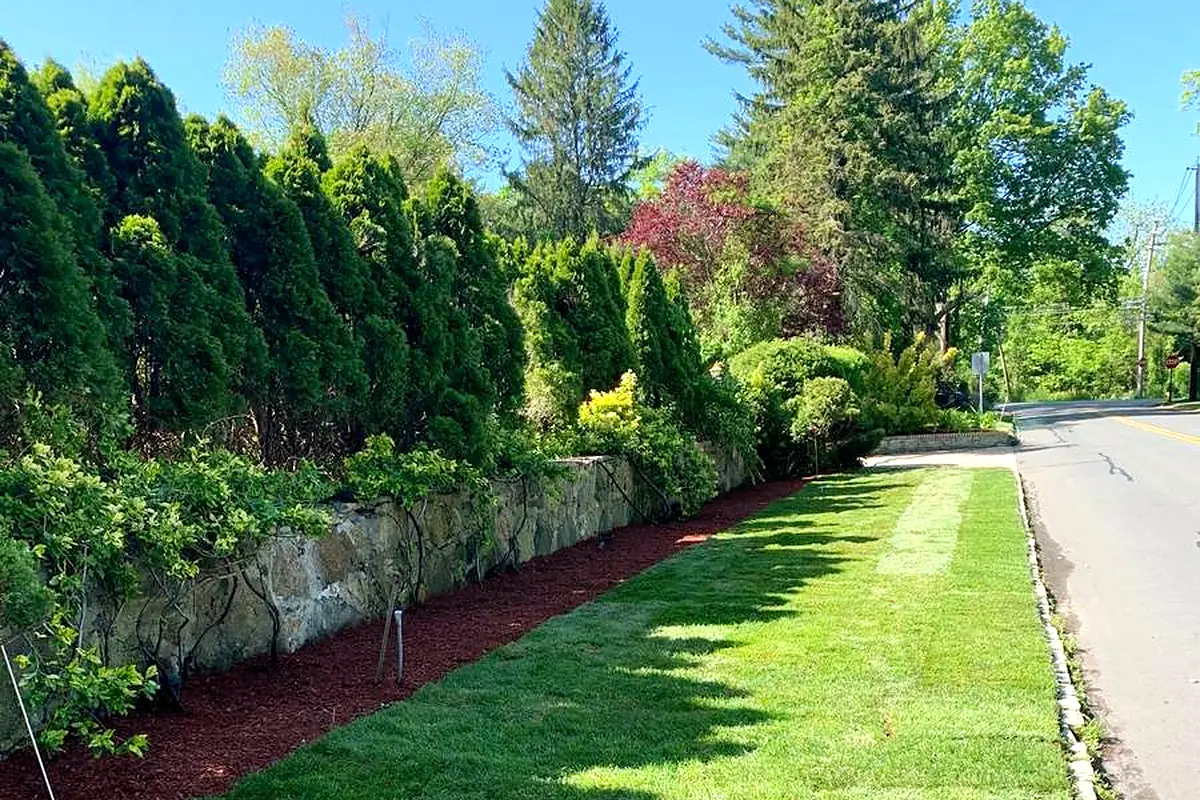
The dry-laid fieldstone walls along the roads and property lines up here were built by hand and they come back the same way. We take the failed length apart, sort the stone, and lay it up again using what is already yours.
The walls out here were built by farmers, not contractors
Northern Westchester was cleared farmland for a couple of centuries, and the stone in these walls came out of the fields they border. Nobody built them as landscape features. They were fence lines, pens, road edges and a convenient place to put the rock the plough kept turning up. Then the farms stopped being farms, houses went up around the walls, and the walls stayed. This page is about dry-laid fieldstone: the old farmer walls and garden walls built without mortar. For an engineered or block retaining wall that is failing, start there instead.
That history is why this is a distinct kind of repair. There is no footing under them, because none was ever dug. There is no drawing. The stone is local glacial rock, mostly gneiss and granite with whatever else the ice left, and the faces carry two hundred years of lichen and weather that cannot be bought off a pallet. A great many are freestanding walls holding nothing back at all, so they do not fail for the reasons an engineered structure fails.
Where an old wall is holding a bank, and plenty of them are, our retaining wall page covers how a wall carrying real load gets designed and built new. This page is about the old ones: property walls, road frontage walls, garden walls, the run along the driveway that has been shedding stone into the grass every spring since you bought the house.
How a dry-laid wall holds itself up
There is no mortar, so friction and weight do all the work, and the wall is really three parts. Two faces, laid so each stone bridges the joint below it and nothing lines up vertically. A middle packed tight with smaller stone, called hearting, which is the part nobody sees and the part that fails first, since hearting is what stops the two faces leaning inward. And longer stones set across the full width at intervals, tying the faces to each other. On top sits the cap course, whose whole job is weight, holding everything under it in compression.
Both faces lean slightly inward as the wall rises. That inward lean is batter, and it is why a well-built dry wall narrows toward the top and survives ground that moves. The wall is designed to flex. A dry wall can settle an inch over fifty years and re-seat itself, which is exactly what a rigid mortared structure cannot do.
Once you know the anatomy, the failures make sense. Hearting works its way down and out, the faces spread, and the wall develops a belly. A cap goes missing and the courses under it have nothing holding them, so the wall unravels downward one winter at a time. A long tie stone gets pulled out by somebody who wanted a flat rock for a step, and the two faces stop being one wall.
It also explains why pointing an old wall with mortar was damage rather than a favour. A dry wall breathes and drains through every joint. Mortar seals those joints, traps water inside a structure with no drainage of its own, and removes the ability to move. Freeze that trapped water a few hundred times and the mortar cracks off in slabs, taking the face of the stone with it. A good share of the truly ruined walls we look at were mortared by a previous owner.
Reading a wall that is going
Old walls fail slowly and they tell you what is wrong if you know the vocabulary. Walk the length once, look at it from the end rather than the side so you can read the line, and pay as much attention to the ground at the base as to the stone.
None of this needs diagnosing from a photograph. If your wall is doing any of it, we will come and look at the run before anybody talks about scope.
What we look for on an old wall:
- Cap course gone or scattered. The most common condition up here and the most urgent. With the weight off the top, every winter takes another course.
- A belly in one face while the other face still reads straight. Hearting has migrated out of the middle and the faces are spreading apart.
- Stones you can rock by hand, or a section that sounds hollow when tapped. The bedding under them is gone and they are riding on points.
- A pile of loose stone in the grass at the foot of the wall every spring. The wall is shedding rather than settling, and it gets weaker as it goes.
- A slumped length beside a tree, or a root visibly running through the courses. Roots grow into the voids and then thicken, and they lift a wall the way they lift a sidewalk.
- The base buried under turf, mulch or a raised bed. Decades of mowing and mulching bring grade up against the wall, hold moisture at the bottom course and heave it out.
- A scoured hollow or exposed subsoil at the toe. Something upslope is now sending water along the base and washing out what the wall stands on.
- Cracked mortar sitting on top of dry-laid stone with the stone flaking behind it. A wall pointed at some stage and now failing because of it.
- A clean break with straight ends. Usually a vehicle, a plough blade or a contractor with a machine, and usually the easiest of these to put right.
Repairing a length, or taking the run down
The good news about dry-laid work is that it is repairable in pieces in a way almost nothing else in masonry is. There is no monolithic structure to compromise. You take the wall apart back to sound work either side of the failure, lay it up again, and when it is finished there is one wall rather than a patch.
Finding the edge of the failure is the skilled part. We work outward from the collapse until the stone stops rocking, the faces come back into line and the coursing reads true, and that point is where the rebuild starts. It is normally further out than it looks, because a wall does not fail cleanly at a boundary. Quoting a repair by pacing off the visible gap is how a job ends up with a second phase in two years.
The signal for a full rebuild is not the size of the belly. It is whether the wall still has a coherent base to lay back onto and whether the stone is still doing what the original builder intended. A run that rocks along its whole length, a wall sitting a foot below the grade that has grown around it, and a wall somebody previously rebuilt with concrete poured down the middle are all cases where a sectional repair buys a season and nothing more. We will say which one you have on the first visit rather than after the invoice.
There is a middle option worth knowing about, and it is what a lot of these jobs turn out to be. One failed length rebuilt properly, the base of the whole run cleared out of the turf and reset where it is buried, and the cap replaced along the length. Nothing else. That stops the clock for a fraction of what a rebuild costs.
Recent work
How the estimate works
- 1Tell us what you need
- 2Walk the property with Nelson
- 3Receive a written scope and price
- 4Schedule the work
Common questions
Not here? Call (914) 486-3682. Someone answers seven days a week.
Stonework is priced by the face area being rebuilt and by how much of it is hand work. What moves the number: the length and height coming down, whether the base can be reused or has to be excavated and reset, how much original stone survives and how much has to be brought in, whether a machine can travel along the run or every stone moves by wheelbarrow, and whether drainage or a grading correction above the wall is part of the fix. Nelson walks the run and writes it out. Looking at it costs nothing.
Usually just the part, and that is the advantage of dry-laid stone. We open it back to where the coursing is true and the stone stops rocking, then lay up from there. The rebuilt length normally runs longer than the gap you are looking at, because the wall is already loose either side of it. A whole-run rebuild is the answer when the base is gone along the length, when the wall has been buried by grade, or when somebody previously rebuilt it with concrete inside.
The salvaged stone matches, because it is your stone going back up. Where material has to come in, we source local fieldstone, set weathered faces outward and keep the fresh-looking pieces low and inside the wall. For the first couple of seasons a sharp eye can find the new work. After that it tones down and stops announcing itself. We would rather show you the two stones side by side on site than tell you it will be invisible.
Related work we do
Most properties need more than one of these. One call covers all of them.
What clients say
I've used Baudi for lawn care, masonry, landscaping and snow removal and do not have a single negative to report. Highly recommend Nelson and his team.
Always taking good care of everything and doing the best job. Attentive, and answers all my questions.
Free on-site estimate
Twenty minutes on site, a written price.
Send a few details and we will come out, measure, and leave you with a written price. No fee, no sales visit, no pressure to sign anything that day.
Prefer to talk? Call (914) 486-3682 or text a photo of the area. Open seven days, 7 AM to 7 PM.
- Phone
- (914) 486-3682
- Hours
- Monday to Sunday, 7 AM to 7 PM
Request received.
Nelson or someone on the crew will call you within 24 hours to set up the walkthrough. If it is urgent, call (914) 486-3682 and you will get a person.