

Mulching & Planting
This is the work that comes back around every spring and every fall: beds re-edged, mulch refreshed at the depth it is supposed to be, perennials cut back, and color swapped out three times a year. The beds themselves get designed and built once. Keeping them right is a standing job.
Mulch gets refreshed, not piled on
Most beds we take over have too much mulch, not too little. Somebody has spread two or three inches every April for a decade and nobody has ever taken any away. The bed now sits four inches higher than the lawn, the crown of every shrub is buried, and the edge has disappeared under the drift. Water runs off that bed instead of into it, and if it is against the house it runs toward the foundation.
Two to three inches is the number, measured from the soil up, not two to three inches added to whatever is already there. On an established bed a refresh is often an inch and sometimes less. What the bed needs in April is the old mulch broken up so it stops crusting over, weeds pulled before they seed, and enough new material to close the surface and bring the color back.
Sometimes the answer is to remove mulch. We pull it off the shrub crowns, take out the buildup until the bed sits at or slightly below the lawn again, and put a thin coat over the top. That is a harder sell than a truckload of new bark, and it is the right call more often than anyone wants to hear.
Why a cone of mulch against a trunk kills the tree
Volcano mulching is the most common thing done wrong in a landscape bed, and it is almost always done by someone trying to help. Bark is not root tissue and it is not built to sit wet. Mulch banked against a trunk holds moisture against that bark year round and the bark begins to rot. It also builds a covered run for voles and mice, who chew the base all winter where nothing can see them. A tree girdled that way does not come back.
The root problem takes longer to show and is worse. Roots grow where water and air are. A deep pile stays damp, so the tree sends roots up into the mulch instead of out into the soil, and those roots wrap the trunk and strangle it years later.
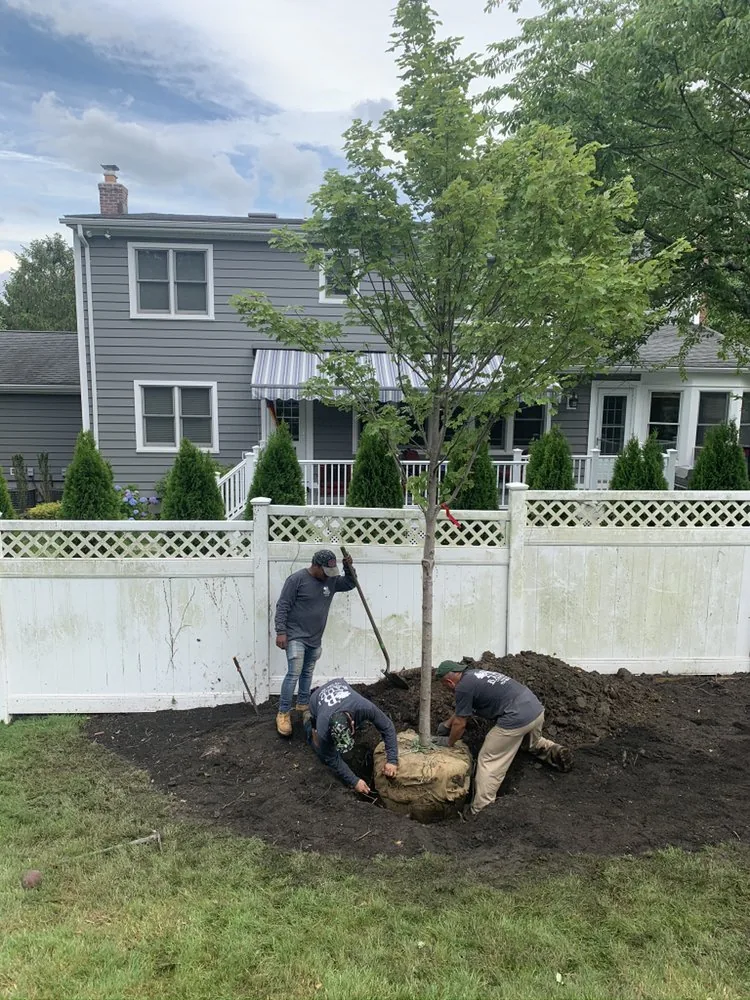
When we mulch around a tree, the root flare stays visible. That is where the trunk widens out into the roots, and it belongs above the mulch line. If it is buried when we get there, we dig it out first and then mulch. Same rule at every shrub: pull the mulch back from the stems and leave them breathing.
The spring visit, in the order it happens
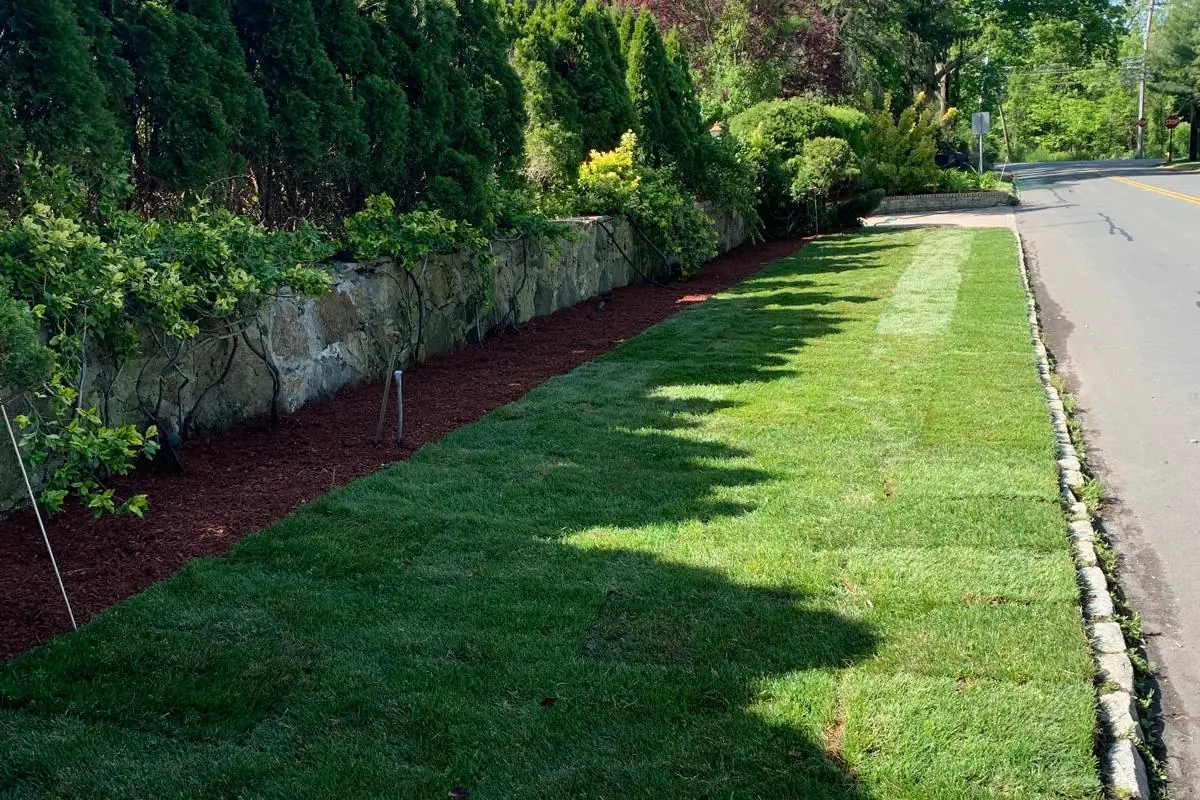
The edge comes first. A crisp bed line is most of what makes a property read as maintained, more than the mulch and more than the plants. We cut it with a spade into a shallow V trench, soil side vertical, so grass cannot creep in and mulch cannot spill out onto the lawn. Plastic and metal edging heaves out of the ground here after a couple of freeze and thaw winters, so unless a client wants Belgian block set properly, we cut a real edge and cut it again the following spring.
After the edge, the bed gets weeded and last year's perennial stems and winter-killed growth come out. Only then does mulch go on, thin and even, pulled back off the crowns by hand.
Timing is set by the bulbs. We want to be in before the daffodil and tulip shoots push through, usually late March into early April, which also gets ahead of weed seed germinating at the warm surface. If we are called later and the bulbs are already up, we mulch around them rather than burying six inches of new growth. Bulb foliage then stays until it yellows and falls over on its own. Cutting it green in May is why a bed of daffodils gets thinner every year.
Mulch types, and what dyed mulch actually is
No single mulch wins. There are tradeoffs, and the right one depends on the bed, the slope and what the client wants to look at.
What we use and what each one does:
- Double-shredded hardwood: the default here. The fibers knit together, so it holds on a slope and does not wash across the walkway in a hard July storm. It breaks down over the season and feeds the soil, which also means it fades toward gray by August.
- Pine bark, shredded or nugget: lasts longer and looks cleaner around foundation planting. Nuggets float, so they do not belong anywhere water runs across a bed or near a downspout outlet.
- Leaf mold and composted leaf mulch: does the most for the soil itself, dark, and what we reach for in a bed being rebuilt or planted with perennials. It breaks down fast, so it needs topping more often than bark.
- Dyed mulch: black, red or brown. It is ground wood colored with carbon black or iron oxide, and the dye is not the problem. The wood is. It is usually recycled pallet and construction scrap rather than bark, it can tie up nitrogen right at the soil surface, and it holds its color long after it has stopped doing anything for the bed. If a client wants black beds we will install and maintain them. We will not tell you it is doing what hardwood or leaf mold does.
Recent work
How the estimate works
- 1Tell us what you need
- 2Walk the property with Nelson
- 3Receive a written scope and price
- 4Schedule the work
Common questions
Not here? Call (914) 486-3682. Someone answers seven days a week.
It comes down to square footage of bed, which mulch you want, how many linear feet of edge have to be cut back in, and the shape the beds are in when we get there. A bed that has not been touched in three years needs weeding and cut-back before anything goes down. Beds with years of buildup may need material hauled out rather than added, which is labor and disposal. Access matters too, since a bed a truck can reach and a bed at the bottom of a hundred feet of wheelbarrow run are not the same job. The walkthrough is free and you get a written scope, usually within 24 hours of the call.
Late March into early April is the window. That is after the ground has dried enough to walk on beds without compacting them, before bulbs are far enough up to be buried, and before weed seed germinates at the surface. Later in spring still works, we just mulch around whatever is already up. Some properties get a light top-off in fall instead.
Two to three inches total, measured from the soil, and none of it touching a trunk or a shrub crown. If your beds are already at that depth, a refresh means turning what is there and adding an inch, not another full layer. Beds that sit higher than the surrounding lawn have too much, and the fix is removal.
Related work we do
Most properties need more than one of these. One call covers all of them.
What clients say
Baudi consistently does an awesome job for us. They are very reliable and efficient, and Nelson is great to work with.
Consistently reliable, on schedule every week for mowing and maintenance. My lawn looks neat, healthy and professionally cared for.
Free on-site estimate
Twenty minutes on site, a written price.
Send a few details and we will come out, measure, and leave you with a written price. No fee, no sales visit, no pressure to sign anything that day.
Prefer to talk? Call (914) 486-3682 or text a photo of the area. Open seven days, 7 AM to 7 PM.
- Phone
- (914) 486-3682
- Hours
- Monday to Sunday, 7 AM to 7 PM
Request received.
Nelson or someone on the crew will call you within 24 hours to set up the walkthrough. If it is urgent, call (914) 486-3682 and you will get a person.