

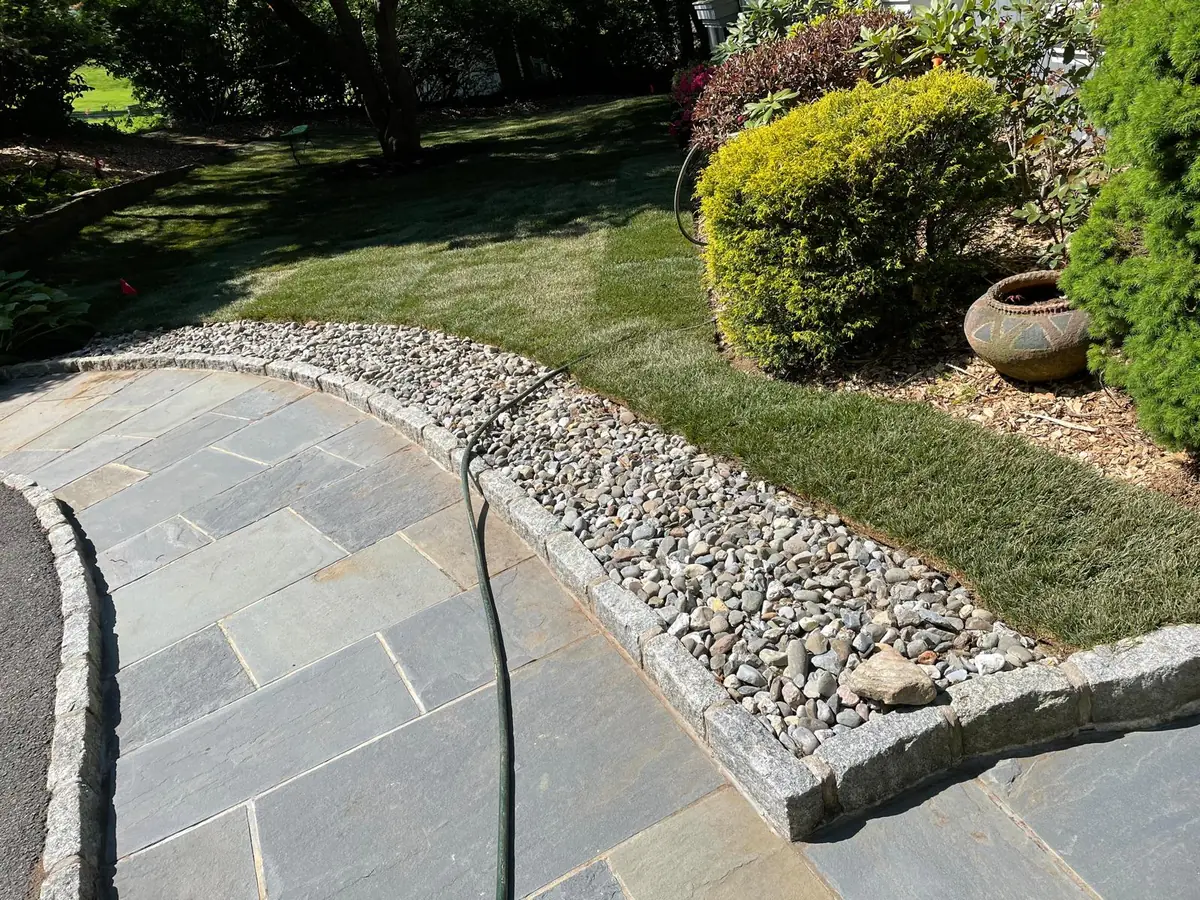
What does a French drain cost, and what sets the number?
A French drain cost comes down to five things: how long the run is, how deep it has to go, what the ground is made of, where the water ends up, and what has to be put back afterward. We do not publish prices, because two yards in the same town can land far apart on those five. Below is how each one moves the number for homes in Mount Kisco, Bedford, Chappaqua and the rest of northern Westchester, and what a low quote tends to leave out.
By Nelson Bautista, Baudi Landscaping · Updated
At a glance
- Length and depth set the base. Every extra foot of trench is more digging, more washed stone, more pipe and more fabric.
- Ledge and tight clay are the biggest swing. Hand work and rock removal are slow, and Westchester soil often has a limit close to the surface.
- The outlet matters as much as the trench. A drain with nowhere to discharge is a buried bucket.
- Crossing a walk, a wall or a mature tree line, and putting the lawn and beds back, are real work that a short quote often skips.
- If the grade is the cause, fixing the grade comes first and may make the drain smaller, or unnecessary.
French drain cost starts with the cause, not the trench
The most expensive French drain is the one that did not need to be built. When water is running across the surface toward a house, the cause is grade or roof water, and a pipe in the ground does not fix a slope pointed the wrong way. Regrading the strip beside the foundation or carrying downspouts away is often a smaller job than a drain. A French drain earns its price when water is moving through the soil: a yard that stays soft for days, or a seep at the base of a slope or on the uphill side of a patio.
So the first line of an honest quote is the diagnosis. If a company quotes a drain without asking where the water comes from, or without looking at the roof lines, you are pricing a guess. Our page on drainage solutions has the steady rain test that separates the two.
Length and depth: how far, and how deep
A drain is a trench, a bed of washed stone wrapped in filter fabric, and a perforated pipe, laid with a steady fall toward the outlet. About 1 percent, an eighth of an inch of drop for every foot, is the working minimum. That fall is why a long run on a flat lot gets deeper at the far end, and a deeper trench is more soil to dig out, more stone to bring in and a wider opening to keep from caving. Doubling a run does more than double the work on a flat yard.
Where the trench has to go also counts. A straight run across open lawn is one thing. A run that follows the uphill side of a patio, turns a corner and picks up a downspout line is another, because each turn needs a way to get a camera or a hose in later. Cleanouts at the turns are part of a real system and are a small add, not an upsell.
Ledge, clay and roots: what the ground does to the number
This is the driver that surprises people. County soil data puts 84.5 percent of rated soil acres in Westchester with a seasonal water table within 36 inches or bedrock within 40 inches (USDA NRCS SSURGO, survey NY119). A trench that has to go 30 inches deep does not have much room before it meets one or the other.
If the trench hits ledge, an excavator is no longer enough. Rock has to be broken or the route changed, and either takes time that cannot be known from the street. Heavy clay digs slowly and holds water in the trench walls while it is open. Roots from a mature maple or oak mean hand digging and a decision about what can be cut. This is why we walk the line before we write the number, and why a quote sent from a satellite photo is a range of guesses.
The outlet: where the water goes
The cheapest outlet is daylight: the pipe runs downhill and discharges on a slope or into a swale where the water can leave the property. When the lot allows it, that is the right answer and it keeps the cost down.
A lot with no downhill side needs something else, usually a dry well or a connection to an approved drain, and those are not interchangeable. A dry well works only if the soil around it will accept water and sits above the seasonal water table and ledge. In soil that does not, it fills and stays full. Discharge also cannot be aimed at a neighbor or a road. If the best route crosses a wetland buffer or a steep slope, the town may want a say, and we cover how that works in our retaining wall permit guide, because the same Bedford boards apply.
Every job here starts the same way: a twenty-minute walkthrough and a written price.
What a low French drain quote usually leaves out
Read what is written, not the total. These are the lines we spell out so you can see what is in and what is not: whether the stone is washed (clean stone moves water, stone with fines clogs), whether the pipe is wrapped in filter fabric, where the outlet is and what it is made of, whether cleanouts are included, how far the trench goes and how deep, and what happens if ledge turns up.
Then ask about the day after. Is the lawn put back as sod or as seed? Are the shrubs that were dug up replanted? Is the spoil hauled away or left in a pile? A trench through a finished yard leaves a scar, and the restoration is often half the labor. A quote that is low and silent on all of this is usually low because those lines are missing.
Be careful with a drain that carries water to the same low spot the problem started in. If the grade is still sending water onto the line, the drain is doing the grade's job and will fill with silt. That is a repair you pay for twice.
Getting a number you can compare
Give every company the same facts: where the water shows up, when (every rain, or only after the biggest storms), and what is uphill. Ask each for the length and depth in writing and the outlet in a sentence. Then the quotes are the same job at different prices, not different jobs with the same name.
Nelson walks the property, runs the water test with you if it is raining, and writes the scope after seeing the grade, the soil and the outlet options. The visit is free.
Common questions
If yours is not here, call (914) 486-3682. Someone answers seven days a week.
It depends on the run length and depth, whether ledge or heavy clay is in the way, where the water can discharge, and how much lawn, wall or walkway has to be restored. We price after a walk, not from a chart. The visit is free.
A downspout extension moves roof water on the surface. A French drain is a trench, washed stone, fabric, pipe and an outlet, plus the restoration. They solve different problems. If water is only coming from the roof, you may not need the drain.
When water is moving through the soil and the grade cannot be corrected, yes. When the cause is grade or roof runoff, fix that first. A drain asked to carry water the grade keeps sending onto it will silt up.
Neither is automatically cheaper. A drain with a downhill outlet is often the lower cost route. A dry well only makes sense where the soil will accept water, and in tight soil or high water table it can fail, so the cheaper looking option can be the expensive one.
Get a French drain quote for your yard
Nelson walks the yard, checks the grade and the outlet options, and writes out the run, the depth and what is included. Call (914) 486-3682 to set up the walk anywhere in Westchester County, from Mount Kisco and Bedford to Katonah and Pound Ridge.
Twenty minutes on site, a written price.
Send a few details and we will come out, measure, and leave you with a written price. No fee, no sales visit, no pressure to sign anything that day.
Prefer to talk? Call (914) 486-3682 or text a photo of the area. Open seven days, 7 AM to 7 PM.
- Phone
- (914) 486-3682
- Hours
- Monday to Sunday, 7 AM to 7 PM
Request received.
Nelson or someone on the crew will call you within 24 hours to set up the walkthrough. If it is urgent, call (914) 486-3682 and you will get a person.