

When to winterize your lawn in Westchester: the next three weeks
If you are asking when to winterize your lawn in Westchester County, the answer for 2026 is that the window is open right now and closes in stages: the last cut and the late fall feeding in the next three weeks, the leaves by the time the oaks finish, and a hard legal stop on lawn fertilizer on December 1. Here is what is worth doing in Mount Kisco, Bedford, Chappaqua and the rest of northern Westchester, in what order, and what is a waste of an afternoon.
By Nelson Bautista, Baudi Landscaping · Updated
At a glance
- Keep mowing until the grass stops growing, then take the last cut a notch under summer height. Long blades mat down under snow.
- A late fall feeding goes on while the lawn is still green. In New York it has to be finished before December 1.
- Leaves are the biggest winter threat to turf. A wet mat left under snow is what becomes gray snow mold in March.
- Seeding is mostly over. Aeration and overseeding belong to September, and sod is the only turf work not tied to that calendar.
- The median first hard freeze in the NOAA records we use is November 12, so the practical window is weeks, not months.
When to winterize your lawn: the order that matters
Winterizing a lawn is not one product or one visit. It is four small jobs in a fixed order, and most of the damage we see in March comes from doing them out of sequence or skipping the one that counts. The order is: the last mow, the late fall feeding, getting the leaves off, and protecting the edges where snow gets pushed.
The reason there is a calendar at all is that cool-season grass does not stop working when the leaves drop. Top growth slows with the cold nights, but the roots keep storing energy until the soil itself chills. What you do in the last weeks before the ground freezes sets how the lawn comes out of winter. In the ten years of daily NOAA records we use for northern Westchester planning, the median first hard freeze fell on November 12 over 2016 to 2024. Some years it is earlier. That is why we tell customers to treat the third week of October through mid November as the window.
The last mow: keep going, then step down
The common mistake in both directions is stopping early or never changing the deck. Parking the mower in mid October while the grass is still growing leaves long blades that fold over under the first snow and hold moisture against the crown. Mowing on at summer height right through November does the same thing, a little later.
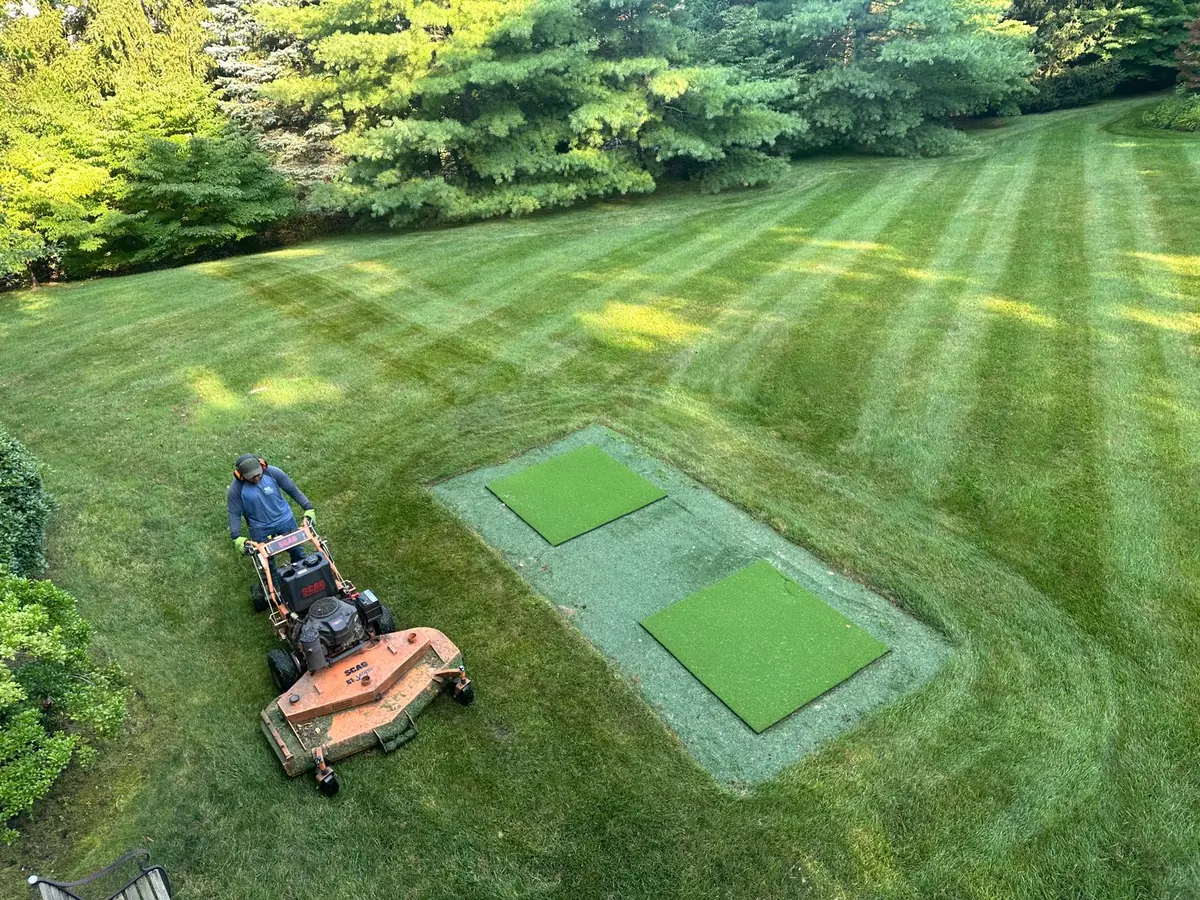
Keep mowing on the usual schedule until growth actually stops, which in northern Westchester is usually the first or second week of November. Over the last two or three cuts, drop the deck a notch each time so the final cut lands a little under your summer height. Never take more than a third of the blade in one pass, which is why it is stepped over several visits rather than done at once. A lawn that was left tall all summer is the one that needs the most careful step down.
The late fall feeding, and the December 1 stop
The one input that is worth doing in fall is a slow release nitrogen feeding applied while the grass is still green and the roots are still taking in nutrients. It does not push top growth. It goes to root and crown, and it is the feeding that shows up as an early green lawn in April.
The deadline is not flexible. New York prohibits lawn fertilizer from December 1 to April 1, and it also cannot go on within 20 feet of ponds, streams and wetland edges, which matters on a lot of the larger Bedford and North Salem properties. So a feeding put off until after Thanksgiving is either illegal or sitting on frozen ground where it runs off. If you are going to do it, it is a late October to mid November job.
If you are thinking of fertilizing a lawn that is thin, weedy or mostly moss, stop. Feeding does not fix those problems. Moss and standing water are drainage and soil problems, and they are covered on our drainage page.
Every job here starts the same way: a twenty-minute walkthrough and a written price.
Leaves and snow mold: the part that kills lawns
A thin layer of dry leaves mulch-mowed into the lawn is fine. A packed layer is not. Wet oak leaves in particular do not shred. They mat down, and snow settles on top and keeps the layer saturated for months. Under that cover you get gray or pink matted circles and bare patches in March, which is snow mold, and the repair is seed, topsoil and a second visit.
The oaks hold their leaves the longest, often into the back half of November, then drop most of their load in a week or two. So the leaf pass that matters is the last one, after the oaks are done, and it has to happen before the first real snow. We cover how many passes a property needs in the fall cleanup cost guide, and the work itself is on our fall cleanup page. A lawn that was last cut and last cleared in the same week is the lawn that comes out of winter clean.
What not to bother with this late
Overseeding in late October is the common one. Seed that goes down now mostly sits, and what does germinate is too young to survive the first hard freeze. Aeration and overseeding were September work, and if it did not happen, the honest answer is to plan it for the front of next fall's window. Sod is the exception, because it is mature turf and is not tied to the seeding calendar.
The second is the pre winter weed spray people add from habit. Broadleaf weeds mostly settle in the fall by themselves, and the real weed control in this county happens in spring, where the timing against crabgrass is what counts.
The driveway edge: where the plow meets the lawn
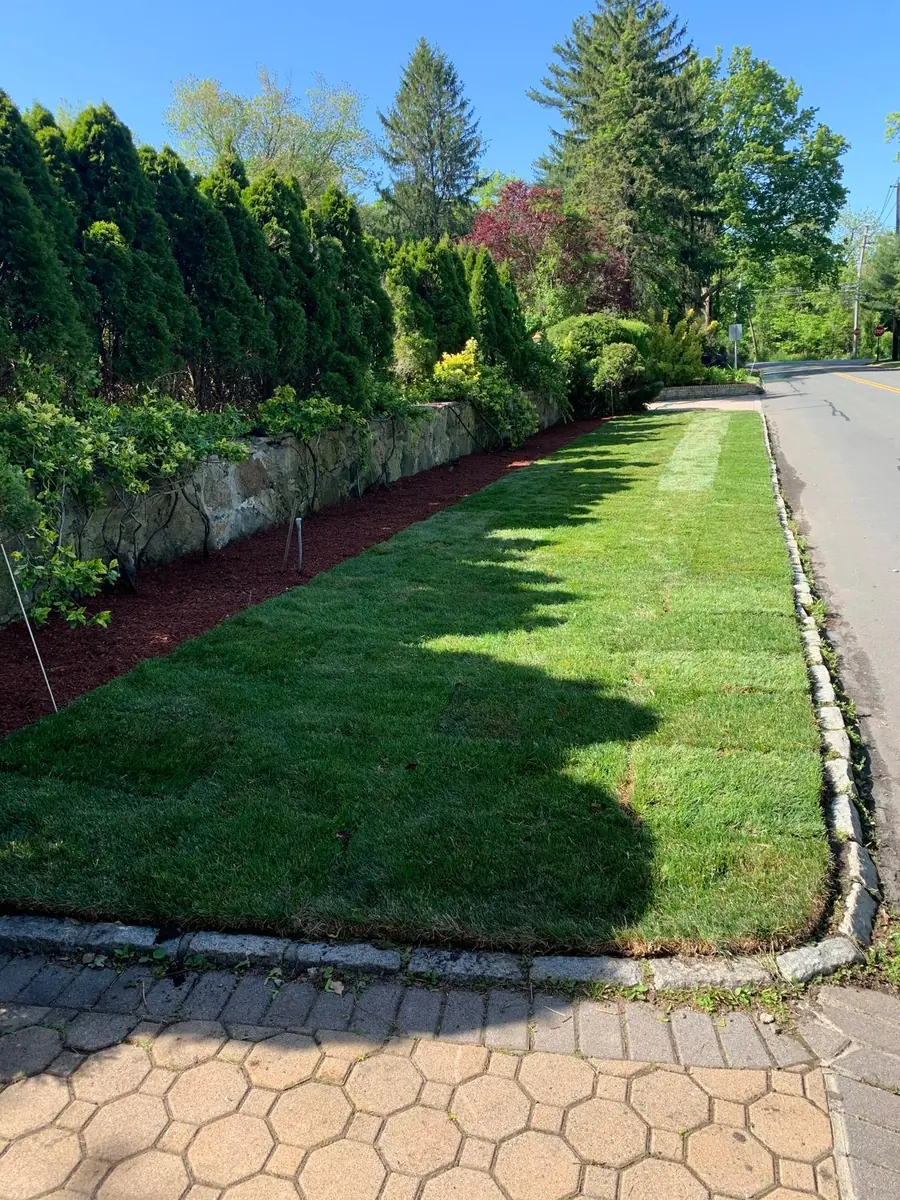
The strip of lawn along a driveway takes more abuse than any other part of the property. A plow blade scalps it if nobody has marked the edge, snow pushed onto it stays for weeks, and road salt burns the grass that it melts into. Mark the edge with stakes before the ground freezes, and keep the salt on the pavement and not on the turf. If you hire the plowing, ask how the edge is marked and where the snow is stacked. We explain how that gets written into a plan in our driveway plowing cost guide.
If seed is off the table, sod is not
Common questions
If yours is not here, call (914) 486-3682. Someone answers seven days a week.
Late October through mid November. Keep mowing until growth stops, apply a slow release late fall feeding while the grass is still green, and finish the leaf pass after the oaks drop. In New York, lawn fertilizer must be finished before December 1.
For fertilizer, December 1 is the legal stop and frozen ground is the practical one. For leaves, it is too late once snow has settled on top of them, though a pass in a thaw is still worth doing. For seed, it is already too late for most lawns this year.
Step the deck down over the last two or three cuts so the final cut lands a little under your summer height. Never remove more than a third of the blade at once.
It helps a healthy lawn, but only if it goes on while the grass is green and before December 1. It does not repair a thin, weedy, mossy or poorly drained lawn, and it cannot go on within 20 feet of water.
Get your lawn through the winter
Nelson walks the property, tells you which of these jobs it actually needs and writes it down. Call (914) 486-3682 to set it up anywhere in Westchester County, from Mount Kisco and Bedford to Chappaqua, Armonk and Yorktown.
Free on-site estimate
Twenty minutes on site, a written price.
Send a few details and we will come out, measure, and leave you with a written price. No fee, no sales visit, no pressure to sign anything that day.
Prefer to talk? Call (914) 486-3682 or text a photo of the area. Open seven days, 7 AM to 7 PM.
- Phone
- (914) 486-3682
- Hours
- Monday to Sunday, 7 AM to 7 PM
Request received.
Nelson or someone on the crew will call you within 24 hours to set up the walkthrough. If it is urgent, call (914) 486-3682 and you will get a person.